If you are wearing a cape to work, it’s time to take it off.
For years, corporate culture has romanticized the "superhero leader"—the solo visionary standing on a hill, swooping in to save the day, and carrying the entire weight of the organization on their shoulders. But in a rapidly changing, highly complex B2B landscape, relying on a single individual is a fast track to bottlenecked decisions, team disengagement, and eventual burnout.
The era of heroic leadership is officially over. To survive and scale, modern businesses must pivot from solo heroes to superhero teams—highly aligned, self-facilitated units where leadership is shared, and expertise is fully utilized.
Achievable Recommendations
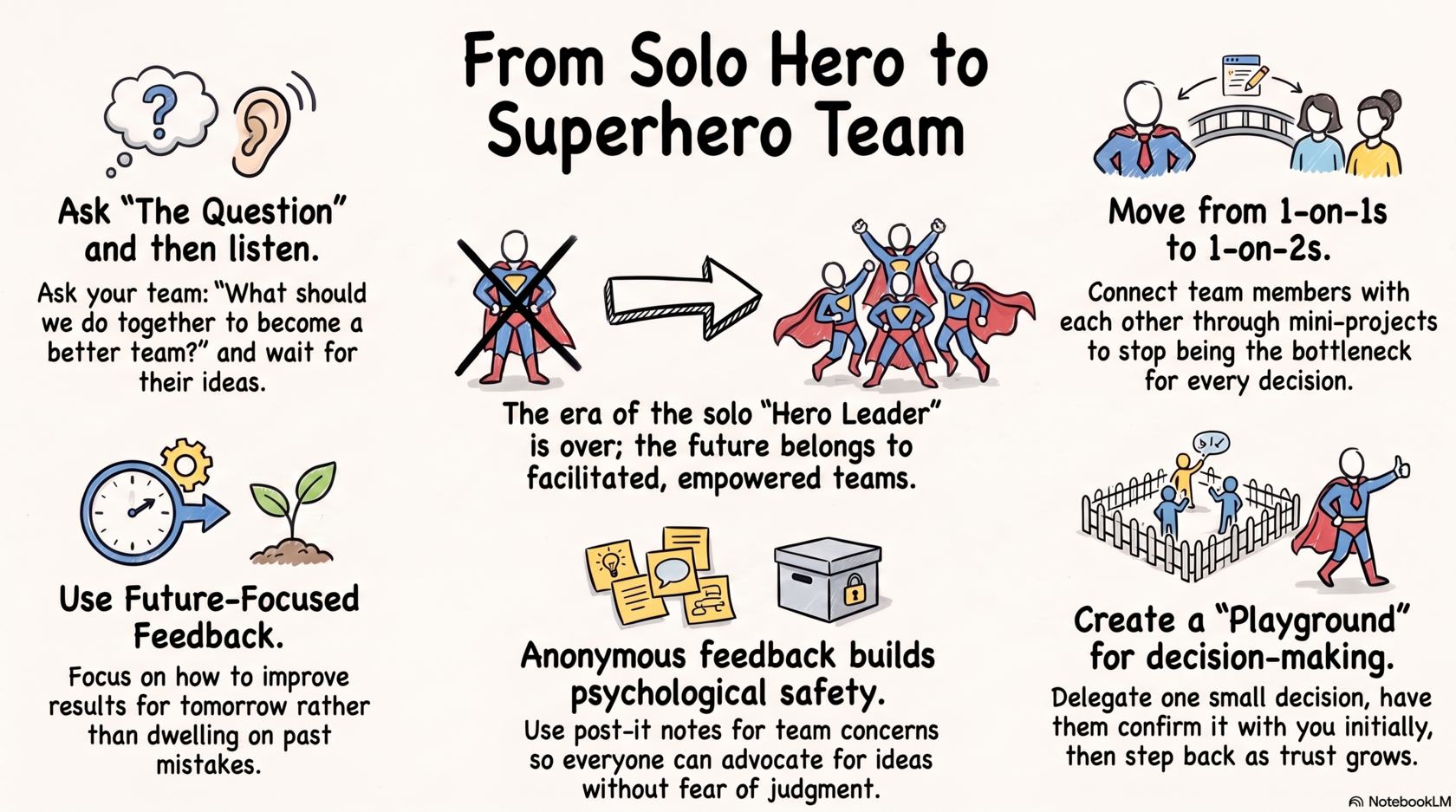
- Ask the "Golden Question" and Stop Talking: Instead of trying to figure out every team-building or operational detail yourself, schedule a meeting, ask your team: “What is it you think we should do together so that we can become a better team?” and then remain completely silent. Let them drive the answers, own the ideas, and establish the criteria for success.
- Build a "Playground" for Step-by-Step Delegation: If you struggle with letting go of control, do not delegate everything at once. Select one small, low-risk decision and hand it over. To protect your peace of mind, ask the team to make the decision, but confirm it with you before executing. Once they demonstrate they can handle it, remove the confirmation step and move on to the next small decision.
- Connect Your Team Horizontally (The "1-on-2" Rule): Over-reliance on weekly 1-on-1s turns the leader into a communication bottleneck where all roads lead to you. Free up your calendar and build team resilience by connecting team members directly through buddy groups, mentoring, reverse mentoring, or collaborative mini-projects. Create multiple peer-to-peer connections so they resolve issues together before coming to you.
- Run "Anonymous Feedback Rounds" with Post-Its: If psychological safety is low, asking "give me feedback" will only net you polite praise. Instead, have everyone write down one anonymous improvement or satisfaction concern on a Post-it note. Mix them up, distribute them randomly among the team (including yourself), and have team members read and advocate for the point on the card they received as if it were their own. Vote on the issues as a team.
- Pivoting to Future-Focused Feedback: Stop dwelling excessively on past mistakes. Frame every piece of feedback around what needs to happen tomorrow, next week, or in the future, outlining how you and the employee can actively support each other to make it happen. This shifts the focus from criticism to collaborative development
Questions This Episode Answers
- Why is solo "heroic leadership" failing in today's volatile business environment?
- How can "control-freak" founders and fast-growing startups successfully transition to delegation without losing sleep?
- How do you translate abstract corporate values into observable, day-to-day employee behaviors?
- What are the practical indicators of psychological safety in a team, and how can you measure them?
- Why are excessive 1-on-1 meetings hurting remote teams, and what is a better alternative?
- How do you run effective team reflection and retrospective sessions if you are not operating in a traditional Agile framework?
Links & Resources Mentioned
"Clicking" – The highly practical book authored by Daria Rudnik, which features deep dives into team development tools, future-focused feedback frameworks, step-by-step templates for anonymous feedback rounds, and team reflection session outlines
Subscribe to our newsletter
According to Daria Rudnik — former Chief People Officer for tech and telecom giants and a veteran leader at firms like Deloitte and Swedbank—the era of heroic leadership is dead. In her view, today’s market complexity moves too fast for any solo protagonist to handle. To survive, leaders must move from a “hero-centric” model to a “people-centered” strategy.
Here are 6 shifts to help you retire the cape and build a resilient, empowered organization.
1. Retire the Cape, Build an “Avengers” Team
The most effective modern leaders have realized that they cannot be the smartest person in every room. When you try to be the solo hero, you create a single point of failure and ignore the vast expertise, networks, and diverse knowledge within your team. Your role must shift from “The Savior” to “The Facilitator.”
Think of this as the “Avengers” model: a group of superheroes where different members take the lead based on their specific skills. As Daria notes:
“The era of heroic leadership is gone; now it’s time [to] empower teams... You all know this team of superheroes that save the world—there is no one single person, but a group of them”
2. The Power of the “One Question” Pivot
Leaders often fall into the trap of over-functioning because they believe they must provide all the motivation and direction. This creates a passive culture where employees “wait to be engaged.” To break this cycle and shift the burden of engagement to the collective, ask this one question:
“What is it you think we should do together so that we can become a better team?”
The secret to this tactic? Could you stop talking and wait? By remaining silent, you leave the team to fill the vacuum with their own ideas and criteria for success. This is a two-way street of accountability; it encourages employees to stop waiting for a cheerleader and start asking, “How can I help you?” to build the culture they want to work in proactively.
3. Create a “Decision Playground” for Control Freaks
For founders and perfectionist leaders, “letting go” feels like losing control. This anxiety is often a survival mechanism from the startup phase, but it eventually becomes a massive organizational bottleneck. To transition without the panic, you need to build the team’s “muscle memory” for autonomy through The Decision Playground.
The process is a disciplined, three-step graduation:
- Identify Small Wins: Delegate a low-risk, tactical decision.
- The Confirmation Step: Instruct the team to make the decision, but confirm it with you before execution. This manages your anxiety while they practice.
- Full Autonomy: Once they demonstrate consistent judgment, remove the confirmation requirement and move to a higher-stakes decision.
4. Stop Being the Bottleneck (Network Resiliency)
Most leadership structures rely on the “hub-and-spoke” model: the leader is the hub, and every team member is a spoke. This makes the network fragile; if the leader is busy, the team grinds to a halt.
To build Network Resiliency, you must shift from a “1-on-1” culture to a “1-to-2” or multi-connection model. Your goal is to connect team members directly so they can find answers without you.
- Buddy Groups: Pair peers for technical support.
- Mentoring Loops: Set up internal growth tracks that don’t involve you.
- Mini-Projects: Assign tasks to pairs to solve collaboratively.
5. Transition to “Future-Focused” Feedback
In her book Clicking, Daria Rudnik outlines a framework that moves away from the post-mortem “blame game.” Traditional feedback often focuses on past mistakes, triggering defensiveness and slowing growth. Instead, adopt Future-Focused Feedback.
Stop dissecting what went wrong last month and start discussing what should happen “tomorrow” or “next week.” As Daria explains:
“Focusing on the future... gives people the understanding that you care about their development and growth... not about their mistakes”
By focusing on upcoming results, you transform feedback from a performance “audit” into a strategic growth tool.
6. The “Anonymous Post-It” Hack for Psychological Safety
You cannot mandate psychological safety; you have to facilitate it. If your team is hesitant to challenge your ideas or admit mistakes, you need a way to detach the feedback from the individual’s voice. This is best achieved through a structured Retrospective exercise:
- The Process: Have every team member write their honest concerns on Post-it notes.
- The Advocate Shift: Shuffle the notes and redistribute them. Each person must read the note they received aloud, advocating for the point as if it were their own.
- The Vote: The team then votes on which issues are most critical to resolve.
By having team members speak someone else’s truth, you remove the fear of retribution and allow the most “dangerous” truths to surface safely.
Closing: Give Yourself a Break
Building a high-performing team isn’t about working harder; it’s about having the courage to be less “needed” daily. The transition from the “Heroic Leader” to the “Empowering Facilitator” is the only way to scale in a complex world.
As Daria concludes: “Give yourself a break... You have a group of people who can be there with you”
Which of your “superhero” responsibilities are you ready to hand over to your team today?