Everyone is talking about digital and AI transformation right now. Companies are pouring millions into new tools, governance frameworks, and operating models—yet so many of these initiatives stall before they ever deliver real value. Why? Because while leaders are busy upgrading their technology, they are ignoring the most critical operating system of all: the human one.
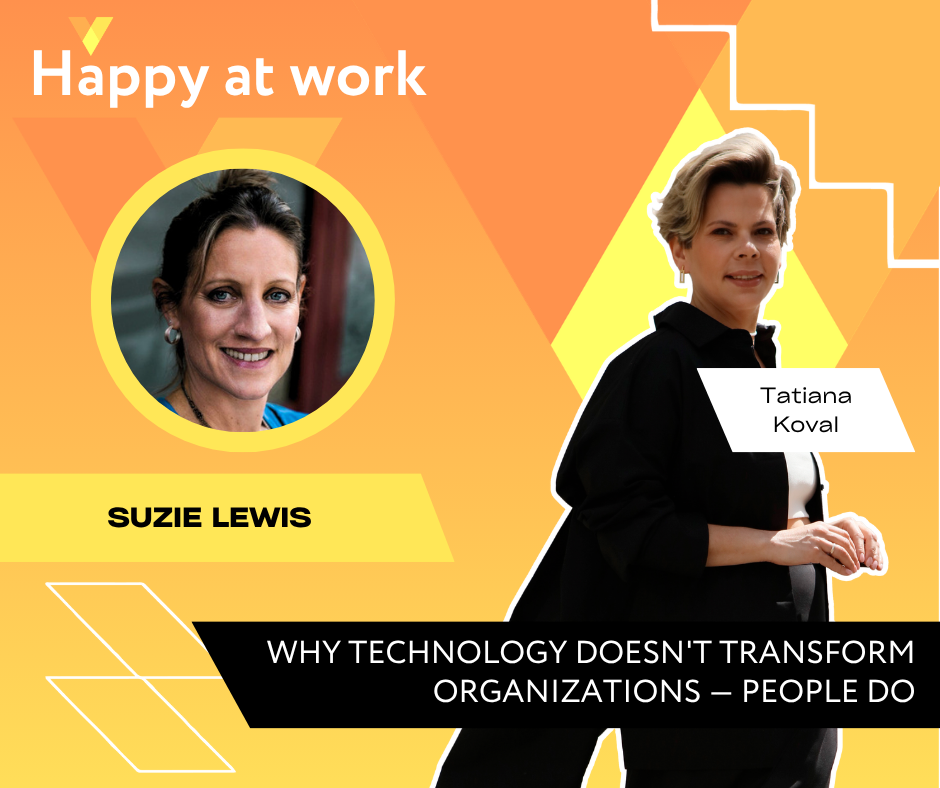
In this episode of the Happy at Work podcast, host Tatiana Koval sits down with Suzie Lewis, Founder of Transform for Value, an executive coach. Together, they look beyond the tech buzzwords to explore the unwritten rules of "human systems"—everything that shapes how people think, feel, act, and interact at work.
Whether you are navigating the stress of AI adoption, dealing with "artificial harmony" and silent meetings, or leading a cross-cultural team through uncertainty, this conversation is packed with practical frameworks. Watch the full episode or read the structured transcript below to learn how to build emotional and relational infrastructure, turn team silence into actionable data, and design a truly adaptive culture..
Top 5 Insights You Will Learn from This Episode
Human transformation fails when you treat culture like a side effect
Culture is not the soft layer around transformation. If you do not design for how people think, act, feel, and interact, the strategy remains an announcement, not a transformation. Before launching a transformation, map the human system first - purpose, vision, expected impact on people, and how humans are involved from the beginning. Then ask what behaviors are being rewarded, reinforced, and ignored.
Psychological safety is not comfort; it is connection under pressure
It is the presence of enough connection that people can stay in the conversation while things feel uncertain, uncomfortable, or risky. A leader builds this by creating space for healthy challenge, using clear communication, and role modeling participation. Small rituals like check-ins, explicit invitations to speak, and visible repair after tension make safety real.
Silence is not calm - it is data
Silence can mean fear, confusion, processing, disagreement, or lack of trust. The leader’s job is to read what kind of silence it is. One of the biggest organizational mistakes is mistaking quiet for agreement. If nobody speaks up, name it and follow up. Give people another forum, allow time to process, and ask again.
Transformation needs a visible map, or people will invent their own story
When leaders are vague about the what, why, and how of change, people fill the gap with fear, rumors, and survival narratives. The more uncertain the environment, the more dangerous ambiguity becomes. Visualize the current system, the target state, the gaps, and the blockages. Explain what is changing, why it matters, and what it means for each group.
AI adoption is a trust problem before it is a technology problem
AI transformation succeeds when people understand their agency in the process. If people do not trust the system, understand the workflow, or know who is accountable, they will quietly resist, work around it, or use shadow tools. Bring people into the idea, proof-of-concept, and workflow design stages. Clarify the purpose of the AI, what it is meant to enable, who owns decisions, and how experimentation will be supported.
Ready to elevate your leadership capability? Tune in to the full episode of Happy at Work for actionable takeaways, real-world case studies, and expert recommendations from Suzie Lewis!
Subscribe to our newsletter
Episode transcription
Suzie Lewis (00:00): People need to feel safe enough to say what is working, what is not working, and where accountability lies—especially if they are not in agreement—and to have trust in what they have put into the AI system and the human systems or the team around it. I think that is really important. That is what will change AI adoption. It is not just about how fast you use the tools or how many people are using them; it is about whether people truly understand where their agency is in that process.
Introduction & The Concept of "Human Systems" (00:46)
Tatiana Koval (00:46): Good morning, good evening, and good afternoon to everybody. This is the Happy at Work podcast. My name is Tatiana Koval. In our podcast, I meet with guests from different parts of the world to discuss a people-centered approach. Today my guest is Suzie Lewis. Hi, Suzie.
Suzie Lewis (01:00): Hi, pleased to be here.
Tatiana Koval (01:02): I am happy to see you here. I know that you are the founder of Transform for Value, an executive coach who helps companies navigate transformation, and the host of the podcast Let's Talk Transformation. You have many different dialogues and conversations about transformation. Today we decided to focus specifically on human-centered transformation. Right now, there is so much talk about digital transformation and AI transformation, so we decided to discuss the human side. What is the most important part of it?
Suzie Lewis (01:39): I call them "human systems"—the human-centric approach is the common foundation for all transformation. When I say "human systems," we often think about systems as mechanical: operating models, governance frameworks, and processes, almost like a phone operating system. If I take that analogy, we see our culture as the wiring around the operating system.
Which it is, but it is human wiring. If I take my definition of culture—which is how we think, act, and interact—it is about human thinking, human action, and human interaction. This is where I like to talk about the human-centric approach and the human systems of an organization. Essentially, it is about how the organization adapts through emotional energy and relationships, how the system learns through patterns and pattern recognition, and how we translate that into an adaptive culture so that we can actually have sustainable transformation.
When I say human systems, it is important to note that we are talking about everything that shapes how people behave, think, feel, and interact at work. And that is written down nowhere. So for me, this is the first conversation, along with: What is the purpose and the vision for this transformation? What impact is it going to have on people? And how do we involve humans right from the beginning?
Building an Adaptive Culture: The Jenga Analogy (03:15)
Tatiana Koval (03:15): That is a great definition of a human system. I really like that you use this approach; when I published posts about our meeting on LinkedIn, the term "human system" immediately attracted attention from the audience. What can companies and leaders do to truly build this type of culture for their organization—not a rigid one, but a really adaptive one?
Suzie Lewis (03:41): An adaptive culture comes from people being able to navigate uncertainty and adapt to the evolving system, evolving processes, evolving market, and therefore evolving technology. I like to talk about emotional infrastructure and relational infrastructure, both of which are really important in terms of equipping leaders and people to create and live within this adaptive culture.
It is about coming back to the human element and asking: what do we need as foundational blocks for this adaptive culture? I like to think of this like a Jenga tower. You have all those different blocks positioned in a certain way. If you don't intentionally think about how you take a block out and put it back in somewhere else, the whole tower could fall over. Even if you just walk past it without noticing, the whole tower could fall over.
I love that analogy because building an adaptive culture requires those foundational blocks of empathy, psychological safety, and emotional regulation so that the system can remain stable enough to hold collective responsibility, a collective vision, and ultimately sustainable change.
Part of what we need to do is training, and part of it is really giving permission for that to be "the way we do things around here"—the way we think, act, and interact. That comes through role modeling and giving permission, of course, but also making sure that those behaviors are seen, heard, and rewarded in the system. Because alongside the human part, you also have the systems. Systems are so important because you can change habits and have brilliant initiatives, but if the system doesn't support, recognize, or help them grow, then it remains just an initiative.
What Is Relational Infrastructure? (05:47)
Tatiana Koval (05:47): Let's talk about relational infrastructure. I remember having a very interesting conversation with an expert, Jason Lauritsen, about the importance of relationships at work and how they influence our sense of belonging. From a leader's perspective, how would you explain what relational infrastructure means, and how can leaders manage it?
Suzie Lewis (06:17): By infrastructure, I mean creating the system that allows these relational skills to be part of the way we work and run things in a team, department, or organization. If I break it down, it starts with really understanding the human: how the human brain works, how we regulate our emotions, and how our internal system works before we can look at leading in a way that allows the rest of our team or organization to do the same.
If I had to break it down into individual blocks, it would be:
- Understanding your own triggers: Knowing my own triggers so that I can understand and interact with other people's reactions and triggers.
- Holding paradox: This is a big one today because there is so much uncertainty. I need to be able to hold two extreme opposites. For example, in leadership systems, I need to be authoritative, yet people also need to feel safe and involved. Understanding that, having the empathy to anticipate how people will react, and adapting as I deliver messages through clear communication is an example of how you start building relational infrastructure.
- Giving permission for healthy challenge and connection: Creating human connection rituals or space for human connection in what is essentially a very busy, fast-moving workday. There is a lot said about psychological safety, but it is not the absence of threat or challenge—it is the presence of connection. As a leader, I need to understand how I can enable that. It is not just training on empathy or emotional intelligence, although that helps; it is also about role modeling what that looks like operationally and inviting your team and peers to actually try things with you.
Intentionally Designing Workspaces and Cross-Cultural Relationships (08:20)
Tatiana Koval (08:20): That is very interesting. From my side, when I talk about the design of relationships, we often have discussions with companies about how this applies to office design. Sometimes we see offices that don't have any space for building relationships—they just have space for working and one big room for meetings. Or, from a cultural perspective, in some cultures people usually eat alone, whereas here in Brazil, for example, people prefer to take a full hour to eat together. Given your extensive international experience, what advice would you give companies on how to design this relationship system across different perspectives?
Suzie Lewis (09:29): My first piece of advice is that it is always about intentionally designing for the result we want. That requires another level of intelligence: cultural intelligence. We need to hold all these different levels of perspective and look at what we can do with them.
To come back to your question, I would advise leaders to map their existing system:
- What works, and what doesn't work?
- Where is the flow of information and relationships, and where is it blocked?
Take a very practical, hands-on canvas approach: Where are we at? Where is the flow? Where are the blocks? What do we need? What is our "minimum viable environment," what would it look like, and what can we pilot to make sure all these things are taken into account?
In parallel, I would speak to all the different employee populations to get as many perspectives as possible—not only on the idea of connection, collaboration, and the physical workspace, but also on the cultural layers that lie on top of that: the national culture layer and the work culture.
Once you have that overview, you can start "playing" with the canvas to see what you can pilot and how to set in motion an iterative process of finding out what works here versus what works there. We will have a top-level understanding of what the environment needs to be like to include everybody and allow for collaboration and performance, but it may look different in different countries. My recommendation is always to visualize it, look at how we translate strategy into operations, and then pilot and iterate in small, bite-sized chunks.
Emotional Infrastructure: Managing Both Positive and Negative Emotions (11:32)
Tatiana Koval (11:32): Thank you for that wonderful answer. Now I want to ask about emotions. Usually, when we talk about workplace happiness, we talk about positive emotions and positive culture. But in reality, at work we experience many different emotions: we can be angry, frustrated by mistakes or misunderstandings, or concerned. When we talk about emotional infrastructure, how can a company organize it? What place should be defined for positive emotions, and what should we do with negative emotions? They are a huge part of our lives, and I don't think we should neglect them.
Suzie Lewis (12:25): We need to have the same type of discussion around naming and visualizing them. All of us need to work on emotional literacy, because many of us have been taught through education and work systems not to express our emotions. We get used to just glossing over people's emotions—particularly negative emotions, which feel difficult to manage—because we don't want to have those difficult conversations.
It is about naming what we want to do in terms of emotional regulation, assessing where we are in terms of maturity and emotional awareness, and acknowledging that while there are both positive and negative emotions, we need both and both are natural. We need to understand what they both contribute to the environment and how we can use them to make sure people feel like they belong and can express themselves.
This often happens through training and coaching sessions on conflict management, having difficult conversations, and getting comfortable with being uncomfortable. Nobody wakes up and says, "I want to manage negative emotions today," but we all have to do it individually. And if you have a leadership role, you often have to interact with other people's negative emotions and read those emotional states.
However, we have to do our own emotional literacy work first: we have to regulate our own nervous systems. For me, teams and organizations are collective nervous systems that regulate each other. We have to be aware of the impact of ignoring certain emotions—or only dealing with positive ones—because it will have a ripple effect through the system. One of the things I hear most in workshops from leaders, and have experienced most in organizations, is that when negative emotions arise, we either gloss over them or we fail to do the necessary repair after a difficult situation. Doing that repair is what allows us to create an environment where people feel safe to express their emotions, whether negative or positive.
Tatiana Koval (14:37): Yes, because when it comes to conflict, one of the most important rules is that it is much better to discuss problems early than to collect them until they destroy the whole system we tried to build. You probably know the popular animated movies about emotions (Inside Out). Both parts of this movie are very popular in schools here in Brazil because they help children discuss their emotions. I think we need the exact same movie for offices and business professionals, because it helps us understand, name, and visualize emotions.
Suzie Lewis (15:31): Totally. I actually do this very often as an entry point into workshops or discussions around culture: getting people to name their emotion beyond just "good," "bad," "okay," or "fine." What are we actually feeling? Let's normalize saying it, and then decide what we do once we have formalized it. Games and visual cards are also great for organizations because they allow people to process emotions differently. If someone doesn't necessarily want to say it out loud, they can pick up a card and show it. It is all about getting used to what I call emotional fluency: naming it, formalizing it, and then actually doing something with it.
Going to the "Emotional Gym": Practical Tips for Leaders of Diverse Teams (16:22)
Tatiana Koval (16:22): That is a great part of cultural transformation toward psychological safety. I want to ask you about the emotions of the leader. A leader of a team or organization is in two roles simultaneously: they are part of the team and organization, and they are also the person responsible for designing relationships and the space where people talk about emotions. In the past, leaders were expected to never show emotion. There is also a cross-cultural perspective—some cultures rarely show emotions, while others express a lot of positive and negative emotions. What would you recommend to a leader managing a cross-cultural or highly diverse team across different generations, genders, statuses, and backgrounds?
Suzie Lewis (18:40): The start of my recommendation goes back to where we began: understanding myself. Can I regulate my own emotions, and therefore recognize when other people are emotionally triggered? Doing my own internal work is the first step.
Afterwards, working with the team involves documenting my understanding of cultural differences around expressing emotions, and recognizing that it is a journey and a muscle. I like to talk about going to the "emotional gym," because it won't happen overnight, and it will happen very differently for everyone—and that is okay.
My advice is to start with small experiments of permission and dialogue:
- Small check-ins: Start every team meeting with a quick check-in: how is everyone turning up, and with what energy? You can use emojis, words, or objects on the screen. What matters is getting your team used to flexing the muscle of expressing how they feel.
- Naming emotional tension: Formalize the fact that there is tension in the room. For example: "I can feel that this isn't okay for some of you. Would you like to express yourselves?" They may say no, but I would still offer that permission and ask that question every single time.
- Role modeling vulnerability: Make it a regular practice to express your own emotions appropriately. For example: "I'm sorry, I'm very stressed right now, can we take five minutes and come back to this?" or "I can feel that everybody is frustrated today—why is that?" or "They've halved the budget on this project, so I imagine people might be feeling X, Y, and Z. Is that correct?"
All of these are simple ways to get people involved in expressing what they might not normally share, while understanding that some cultures won't express themselves in the same way or at the same speed. Maybe someone will write an email later because they don't want to speak up in public—either way, the muscle is being worked. And don't get disheartened if nobody speaks, because silence is also an indicator. I started my career in supply chain doing Lean, and silence is like the Andon early warning system—it is a light that goes on. It is telling you something; it is data. Often we are scared of silence, but it can also leave the necessary space for people to think, "I'm not used to doing this, but I'm going to say what I feel anyway."
Decoding Silence: When the Real Meeting Happens After the Meeting (21:59)
Tatiana Koval (21:59): Those are great practical tips. If you don't mind, I want to ask you more about silence as a sign of problems. Often, a leader asks at the end of a presentation, "Do you have any questions?" and everybody says, "No, everything is okay." But then, everyone starts a huge discussion outside the meeting room because they actually had a lot of questions, but were afraid to ask. What do you recommend doing in that situation?
Suzie Lewis (22:43): Silence is not necessarily a problem in itself—it is data for you. In the situation you just described, that silence is telling me that people do not feel safe enough to speak up. In other situations, silence is simply processing time.
So the first step as a leader is to look at the silence and ask: "What is going on behind this?" That is why I love working with humans—it is messy, what you see is never what you get, and there is always something going on underneath.
In your example, where people don't feel safe to speak up, as a leader I would name that—maybe not in the exact moment, but in a follow-up—asking people for their input and what they thought, because I genuinely want to know. Second, I would examine why people are not speaking up in those meetings.
At the same time, there is power in silence for letting people process. You can use silence intentionally and then come back and say, "Now that you've had a little time to reflect, are there any questions or inputs?" If they still don't answer, you need to find a way to give them permission to share their opinion in a different forum first, while you work on changing the main meeting forum so that people eventually feel safe to speak up there.
AI Transformation & Psychological Safety (24:29)
Tatiana Koval (24:29): Let's connect this to AI transformation. AI transformation doesn't work without human system transformation. When a company starts a transformation, it is a time of stress and psychological unsafety, yet leaders still need to deliver results. When talking about the human system during an AI transformation, what should leaders take into account first?
Suzie Lewis (25:05): You have to be intentional about the culture and the conditions you need for people to adopt AI and transform how they work. In terms of psychological safety, it is about creating the conditions for people to speak up and trust not only their human team, but also agentic-human collaboration.
We need psychological safety in the team to say what is working, what isn't working, whose accountability it should be, and to revisit workflows when needed. People need to trust what they have put into the AI system as well as the human systems around it. That is what will truly change AI adoption—not just measuring how fast you roll out tools or how many people log in, but whether people understand where their agency is in that process.
I worked with an innovation team for two years on how to install adoption in the human layer right from the initial idea to the proof of concept—rather than waiting until the proof of concept is finished, saying "Now deploy it," and finding out that nobody trusts it or understands what it means for them.
I advise leaders to create conditions where people feel safe enough to experiment together around a clear purpose. AI is not just a tool; there is a business outcome and a purpose behind why we want to use it. Which workflow does it apply to, why, who does it affect, and how do we manage that change together with the team? If nobody speaks up in meetings, AI adoption becomes very difficult because you have mistrust in the human system and mistrust in what AI is going to do—fueling normal internal stories like, "It's going to take my job, what am I going to do?" Team rituals, giving permission, role modeling, and creating a blame-free space to speak openly are the building blocks for a successful AI transformation.
Early Warning Signs of a Broken Human System (28:06)
Tatiana Koval (28:06): Sometimes, when silence or dysfunction is the norm in an organization, leaders don't even realize it is a problem because they are used to it. What other early warning signs should companies look out for to recognize that they have a problem in their human system?
Suzie Lewis (28:32): Often, when we are too close to a subject, we can't see it—especially if the system we put in place is still delivering short-term results. If we step back and look for early warning signals—like that Andon light—here is what I observe most often in teams during transformation:
- Tangible disconnection: Communication becomes purely transactional. People only interact through Microsoft Teams pings or texts, and when they are face-to-face, they don't discuss real issues.
- Lack of collaboration and siloed thinking: During project reviews, one side doesn't know or care what the other side is doing. You hear phrases like, "That's not my budget, that's his budget or her budget." That shows a blocked flow of information and relationships.
- Artificial harmony: As you described earlier, people sit in silence during the meeting, and the real meeting happens outside in the hallway afterwards. Or people say, "We agree on everything." That is a huge red flag for me, because no team of humans ever agrees on everything all the time unless someone isn't speaking up.
- Survival mode and lack of sense-making: When people are in survival mode, their brains don't have the distance needed for sense-making. If you ask, "What is the bigger quest for your business with this project?" and you get 12 different answers, communication is not aligned.
- Superficial sameness: Everyone uses the exact same buzzwords and says, "Yeah, we're going to do this because we need to," but there is no substance or genuine engagement behind it.
- Lack of trust and "Shadow AI": People think, "I'll use a different AI tool, but I won't tell you about it."
These are all natural human reactions to change—it is not about blame or judgment, it is an observation. At an organizational level, you also see warning signs when governance is unclear or when organizational design and processes don't match what leaders are asking people to do.
Preparing for Transformation: The Surgery Metaphor (32:22)
Tatiana Koval (32:22): Transformation is usually very difficult for organizations and employees—nobody really likes transformation except maybe us as consultants! To use a health metaphor: undergoing surgery is tough on the body, even though it makes us healthier in the future. Before surgery, a patient prepares physically and mentally. Transformation is like surgery for an organization, yet leaders often forget about preparation and jump straight into the process. How can a company prepare its leaders and employees for transformation?
Suzie Lewis (33:53): Often transformation happens so quickly that we don't have time to prepare everyone ideally. However, if we look at three lenses—physical infrastructure, intellectual infrastructure, and emotional infrastructure—my advice is to assess the current situation through those three lenses, look at where you want to go, identify the gap, and start communicating about that gap as much as possible.
Even when you don't have all the answers yet, communicating is very reassuring: "We will be progressing on X, Y, and Z." Be as explicit as possible about where we expect people to be, what the impact will be, and how we are asking them to join us on this collective journey.
Why? Because explicit communication cuts off fearful internal narratives. If I leave you in the dark about a change, you will invent all kinds of stories in your head—we all do. The more explicit we are about the what, the why, and the how, the easier it is for people to process. And because the speed of AI leaves us with even less preparation time today, a leader's ongoing job is to build that emotional and relational infrastructure all the time, so that when high pressure hits, the structure is already there for people to regulate and support each other.
Supporting Teams During Transformation: The 4 Pillars (35:47)
Tatiana Koval (35:47): Since we are right in the middle of rapid AI transformations and often don't have time to prepare in advance, what practical rituals or frameworks can companies use during the transformation period to support leaders, employees, and the organization as a whole?
Suzie Lewis (37:27): We can answer that with a simple four-part framework that every team can deploy in its own way: you need Clarity, Accountability, Support, and Care.
- Clarity: Being clear on where we are going with the transformation, why we are doing it, and—in the case of AI—what exactly we are asking AI to enable.
- Accountability: Defining what this means for governance, people's roles within that governance, and who decides on what.
- Support: Identifying what practical help people need. Do we need coaches, training, or hands-on innovation labs on the ground? How are we supporting people to experiment, fail, and rebuild?
- Care: Care is a huge one. Many workplace cultures today are built to compete and compare, whereas we need cultures of collaboration and care. Care drives wellbeing, performance, and innovation, but it must be intentionally designed into the system and communicated as an objective: "We care for our people, and this is what it looks like." Ask your people: "What does care look like for you? Do you feel included? Do you feel supported?" Those conversations provide invaluable data. It is like putting tokens into a "care jar" so that when things get intensely busy, there is still something left in the jar to draw from.
Summary: 3 Key Takeaways for Leaders (39:27)
Tatiana Koval (39:27): Suzie, thank you so much for all your practical recommendations. To sum up our 40-minute conversation, what are your top three tips for leaders who want to transform their human systems and become more human-centered?
Suzie Lewis (39:55): If I could only give three tips, they would be:
- Understand yourself: Know your own internal operating system—who you are as a leader, how you react, and how you think, act, and interact with others. Regulating your own emotions is what allows you to help regulate the emotions of others.
- Visualize your system: Step back from daily busyness and map where your team or organization actually is. See where relationships and information are flowing well, and identify where the gaps and blockages are.
- Co-create the practice with your team: Work together with your team to get that energy flowing again and find rituals that work for you. Culture evolves just as people evolve, so it will never be a one-size-fits-all solution—there will always be tweaks needed along the way.
Tatiana Koval (41:26): Thank you for such a brilliant conversation.
Suzie Lewis (41:28): Pleasure. I've loved it. Thank you very much.
Tatiana Koval (41:32): This is the Happy at Work podcast. Stay connected!