What if luck isn't a random roll of the dice, but a business capability you can actively design and scale? In this episode of the Happy At Work podcast, host Tatiana Koval sits down with researcher and author Christian Busch to deconstruct the science of serendipity. Busch reveals that the most successful, purpose-driven leaders don't just wait for happy accidents—they systematically cultivate a "serendipity muscle" by transforming unexpected moments into powerful opportunities. Whether you are looking to drive organic innovation in your team, expand your high-impact network, or navigate professional career shifts, this conversation offers a refreshing, highly actionable blueprint for turning the unexpected into your company's greatest competitive advantage
Achievable recommendations
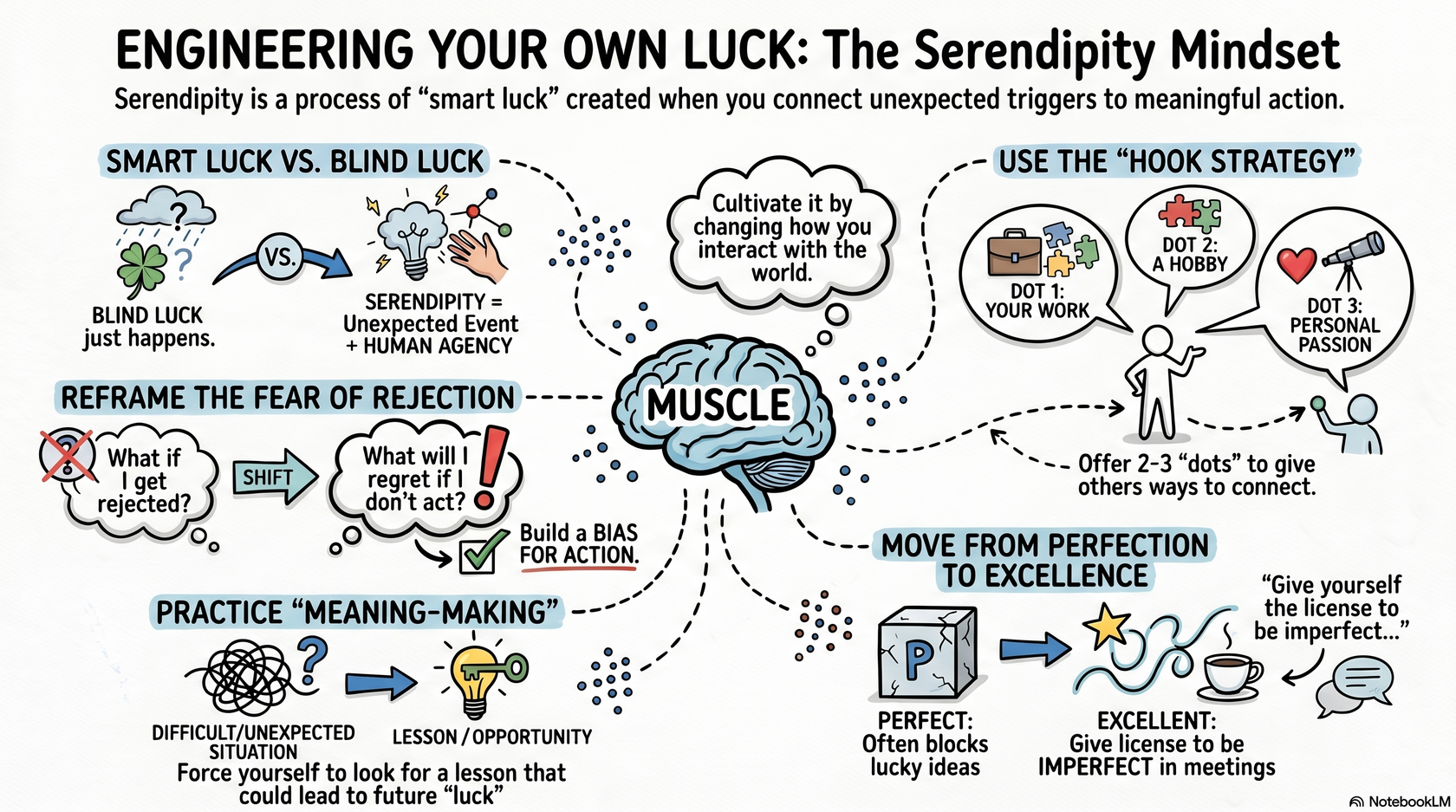
- Seed "Hooks" in Every Conversation to Drive Organic Overlaps. Instead of relying on standard pitches or dry status updates, use the "hook strategy" by weaving two or three meaningful, diverse elements of your current focus or personal life (such as a specific project angle, an interest, or parenting) into everyday interactions. This creates multiple points of connection, allowing colleagues and external partners to easily "connect the dots" and open doors to unexpected, high-value collaborations.
- Shift Meeting Cultures from Perfection to Excellence through Trigger Questions. Help your team spot hidden opportunities by embedding simple, open-ended "trigger questions" into your routine workflows. For example, start or end weekly meetings by asking, "What surprised you last week?" This prompts employees to pay attention to unexpected data points or shifting patterns, transforming routine catch-ups into strategic innovation sessions while pivoting the culture from defensive perfectionism toward authentic excellence
- Overcome the Fear of Rejection via Regret Minimization and Low-Risk Practice. The biggest bottleneck to serendipity is our failure to act on unexpected ideas or connection points out of fear of rejection. Reframe your mindset from "What could go wrong if I do this?" to "What do I lose or regret if I don't do this?" To build this action bias, practice putting yourself in low-stakes, low-risk rejection scenarios (such as asking for an unusual minor discount or a favor) to desensitize your brain to the word "no"
Questions This Episode Answers
- How does "blind luck" differ from "serendipity," and what is the exact step-by-step process we can use to transition from passive bystanders to active creators of smart luck?
- How can introverts or senior executives leverage the "hook strategy" to bypass transactional networking and build deeply authentic, high-impact professional relationships?
- What specific managerial practices can leaders implement to move their company culture away from rigid perfectionism and toward a state of adaptive clarity and psychological safety?
- How can we utilize the "Regret Minimization Framework" to make difficult personal and professional decisions that align with our deepest core values
Links & Resources from episode
- Christian Busch LinkedIn Profile
- "The Serendipity Mindset" by Christian Busch — Christian's book which serves as a practical guide to cultivating active, smart luck in work and life
- "Man's Search for Meaning" by Viktor Frankl — A highly recommended book on finding meaning through adversity, which serves as a philosophical foundation for navigating unexpected life crises
- "Give and Take" by Adam Grant — Mentioned by host Tatiana in the context of relational networking and how offering value to others helps build a robust professional network.
Subscribe to our newsletter
In high-stakes professional environments, we often misattribute market leadership and career breakthroughs to mere luck. We see the unexpected partnership or the “overnight” success and assume it was a lightning strike of fate. However, as Dr. Christian Busch argues, this perspective is a strategic blind spot.
1. Luck is a Process, Not an Event
The foundational shift for any growth-minded professional is understanding that serendipity is a repeatable process. Dr. Busch defines it through three distinct phases:
- The Trigger: An unexpected data point or encounter (a spilled coffee, a missed flight, a random remark).
- Meaning-Making: The intellectual labor of “connecting the dots” between that trigger and a potential opportunity.
- Action: The initiative to follow through before the window of opportunity closes.
Viewing luck as a process rather than a static event restores agency to the individual. It reduces the anxiety inherent in volatile markets by providing a framework to convert “noise” into “signal.” Human agency is the bridge that turns a random trigger into a strategic breakthrough.
Consider a standard encounter: you accidentally spill coffee on a stranger in a cafe. You can apologize and leave (blind luck/accident), or you can leverage the moment to start a conversation. That stranger could be your next co-founder. The spill was the trigger, but serendipity only occurs if you find meaning and act.
2. The Hook Strategy: Turning “Push” into “Pull”
Traditional networking is often transactional, exhausting, and ineffective. A Strategic Growth Advisor utilizes the Hook Strategy to seed “dots” in every conversation, allowing others to find meaningful overlaps.
Instead of a one-dimensional “elevator pitch,” offer multiple entry points.
- Standard Title (Low Serendipity): “I am a researcher and academic.”
- The Serendipity Hook (High Serendipity): “I study serendipity, but I’m also currently fascinated by parenting because my four-year-old has just started negotiating every bedtime.”
This strategy is particularly potent for introverts at large events. During a Q&A session, instead of a standard pitch, frame your question like this: “Thank you for the talk. As someone who is currently [Hook about your project/interest], I was wondering [Question for the speaker]?” This turns a “push” into a “pull”—after the session, people with similar interests will naturally gravitate toward you because you’ve publicly seeded a hook.
3. Move from Certainty to Clarity: The Pixar Model
In a world of “perfectionism,” many leaders wait for a 100% certain outcome before acting. This rigidity blocks serendipity. Dr. Busch highlights Pixar’s culture as a masterclass in trading perfection for excellence.
At Pixar, there is an organizational acknowledgment that every masterpiece begins as a “bad idea.” By moving from a demand for certainty (which is impossible in an unpredictable market) to a demand for clarity (clear values, priorities, and direction), they create a safe harbor for unfinished ideas.
Excellence allows for the “imperfect” learning necessary for success. When you bring an unfinished thought to the table, you invite others to help you connect the dots. An obsession with perfection shuts the door on the very collaboration that triggers strategic luck.
4. Management Tactic: Training the Organizational “Eye”
To engineer serendipity at scale, leaders must train their teams to spot triggers. A simple yet transformative management tactic is to ask one question in every weekly meeting: “What surprised you last week?”
This forces employees to look past the planned KPIs and notice the anomalies. If a team member says, “Younger customers aren’t responding to our traditional incentives,” that surprise is a trigger. If the team makes meaning of it and acts, a market pivot that looks like “luck” to competitors becomes a strategic win for you.
5. The Regret Minimization Framework
The primary bottleneck to serendipity is the fear of rejection. To overcome this, Dr. Busch advocates for the “Informed Gut” approach, shifting the psychological focus from “fear of rejection” to “fear of regret.”
When faced with a high-stakes decision—such as choosing between a prestigious speaking engagement and a family milestone—ask: “Which choice will I regret more on my deathbed?” Dr. Busch often chooses his daughter’s school festival over professional events because, while the engagement makes sense on a spreadsheet, the regret of missing the festival would last for years.
As he notes: “It’s actually much riskier to not do it because of that feeling of regret.”
6. Strengthening the “Rejection Muscle”
Engineering luck requires a high tolerance for the word “no.” Dr. Busch suggests “Serendipity Experiments”—low-stakes risks designed to desensitize the brain to rejection.
Example: Ask a barista for a free coffee because you “forgot your wallet,” or ask a store clerk for an “employee discount” just to see what happens.
The goal isn’t the free coffee; it’s the realization that rejection isn’t fatal. One father who tried this was jokingly granted an employee discount simply because his request was so human and unexpected. This “muscle” is what allows you to act on high-stakes serendipitous moments when they appear in the boardroom.
7. Meaning-Making: Signal vs. Noise in Crisis
Strategic resilience is the ability to find a “signal” within a crisis. This is not “toxic positivity”—it is active narrative architecture. When Dr. Busch’s house was destroyed in a wildfire, he didn’t pretend it was a positive event. Instead, he forced himself to find meaning within the pain.
This led to his research into “bad luck by design” and the spirals that cause it by asking, “How can this become a new direction?” Even in total loss, you ensure that you are never a victim of circumstances, but an author of the next chapter.
A Life of Potentiality
Strategic success is not a set path; it is a field of potentiality. When we stop trying to control every variable and start looking for triggers, seeding hooks, and acting on our informed gut, we move from being observers of luck to its engineers.
Your Challenge: Please don’t leave your next three professional calls to chance. Seed at least one “hook” (a current curiosity or a personal dot) in each and observe how the “dots” begin to connect themselves. Your next breakthrough is likely already in the room—it’s just waiting for a hook.