For decades, organizations have rewarded employees for physical fitness and stress management through well-being programs. But true well-being t is a holistic job rooted in how our jobs are designed, how our meetings are run, and how we connect as human beings. In this deep-dive discussion, workplace well-being pioneer Jessica Grossmeier reveals why we must look beyond superficial perks to build sustainable, human-centered workplaces that truly foster high performance and genuine joy.
Achievable Recommendations
- Redesign Meetings for Connection: dedicate the first 5 minutes of your meetings to non-transactional human connection. Try interactive, lighthearted check-ins like a "weather forecast" mood check or a quick "favorite kitchen gadget show-and-tell" to break the ice and build trust.
- Establish "Joy Spotting" Slack Channels: create low-barrier channels where team members can share small, positive moments from their day. Prompts like "Share one thing that made you smile today" help remote and hybrid employees feel seen and connected.
- Reframe Mistakes as Data Points: Instead of labeling a misstep as a "failure"—which triggers the brain's habenula and crushes motivation—reframe it as an iteration or an experiment. Treat mistakes as valuable data points to pivot quickly with self-compassion.
- Actively Combat Invisible Labor: eradicate "joy killers" by actively expressing appreciation and recognition. A simple, targeted thank-you note (e.g., "Thank you for the energy you brought to the room today") makes people feel seen as humans rather than transactional roles.
Questions This Episode Answers
- Why are traditional wellbeing tools like yoga and meditation apps insufficient for preventing burnout on their own? Burnout is a systems issue, not an individual one, and must be addressed through job design, flexibility, and manager-employee relationships.
- How can team leaders effectively combat remote employees' loneliness?By establishing regular 30-minute check-ins that prioritize personal sharing over performance metrics, using fun round-robin prompts, and creating dedicated Slack channels for casual interactions.
- How does shifting our focus from "personal happiness" to "being of service" transform our work experience? Focusing solely on our own desires makes finding joy harder, whereas shifting our frame to "how can I make your job easier" builds deep, supportive relationship networks that buffer work stress.
- What are the 3 core starting points for a leader wishing to build a human-centered workplace? Aligning work with personal values, showing more vulnerability and humanity, and actively spotting joy in daily life.
Links & Resources Mentioned
- Jessica`s LinkedIn Profile
- Jessca`s book "Well At Work"
- Mihaly Csikszentmihalyi's book "Flow"
Subscribe to our newsletter
For many of us, the modern workday has devolved into a relentless cycle of back-to-back meetings with zero breathing room for human connection. We are living in a digital-first world where work often feels purely transactional—a series of pings, agendas, and checklists. This isn’t just exhausting; it’s a fundamental threat to the performance and health of our organizations.
As a culture strategist, I’ve seen the definition of well-being undergo a radical transformation. While the field was once synonymous with physical fitness and stress management, the research of experts like Jessica Grossmeier shows that well-being has evolved into a critical leadership skill. It is no longer a “nice-to-have” perk; it is a baseline for sustainable high performance.
To build organizations that thrive, we must shift the conversation. Well-being is not an individual burden to be solved by a weekend retreat; it is a collective competitive advantage. Here are five counterintuitive truths that redefine what it means to lead a healthy, high-performing team.
1. Burnout is a Systems Issue, Not a Personal Failure
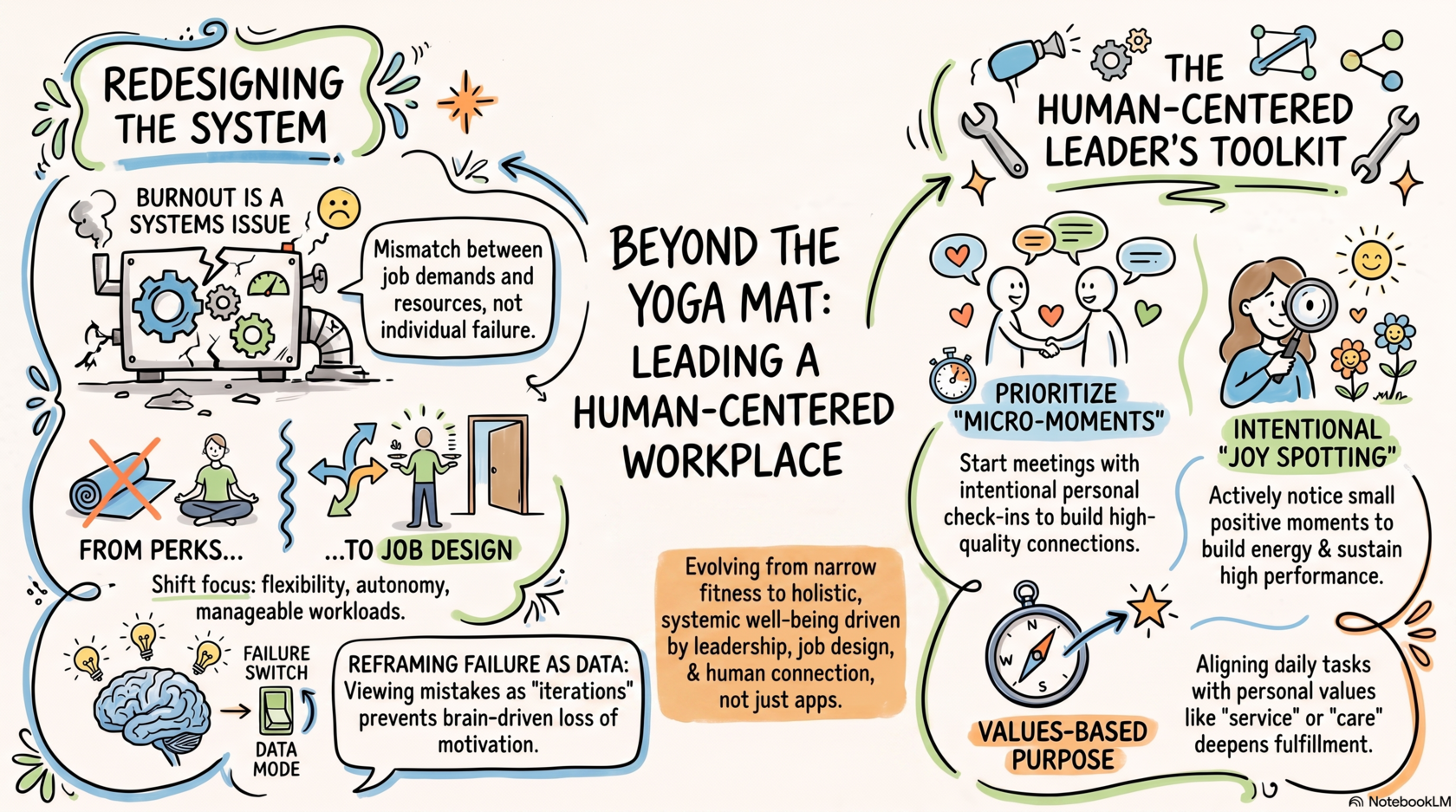
We must stop treating burnout as a lack of “grit” or a personal failure of resilience. The research is detailed: burnout occurs when there is a chronic imbalance between job demands and the resources available to meet them. When we tell an exhausted employee to “take a long weekend,” we are applying a bandage to a systemic wound.
To address burnout, we must move “upstream” and examine job design. This means actively clarifying priorities so that “everything” isn’t treated as urgent and offloading tasks when capacity is reached. High performance is sustained not by how much an individual can endure, but by how well a system supports their focus.
“Burnout is actually a systems issue, not just an individual issue. The reason we get to burnout is that we have been overlooking... prioritizing and clarifying what’s most important.”
2. The Neuroscience of Failure: Data Points vs. The “Habenula”
For the “recovering perfectionists” in our ranks, a mistake often feels like a character flaw. However, neuroscience reveals a deeper mechanism at play. When we label an event a “failure,” we activate the habenula—a tiny brain structure that acts as a “failure switch.” Once triggered, this switch suppresses the brain’s reward system, kills motivation, and creates an overwhelming urge to quit.
As leaders, we can prevent this “motivation kill-switch” through a cognitive reframe. By viewing mistakes as “data points,” “iterations,” or “experiments,” we keep the brain’s motivation center active. When we treat a setback as an informative data point rather than a failure, we allow our teams to pivot quickly and maintain the energy required for innovation.
3. The ROI of “Micro-Moments” of Connection
In a remote or hybrid environment, isolation can be a significant performance killer. Research from the University of Michigan highlights that “higher quality connections” are the primary drivers of resilience. These are not “perks”—they are “resilience buffers” that reduce the high costs of turnover and disengagement.
Building these connections doesn’t require a day-long retreat. It happens in “micro-moments” of intentionality that humanize the screen. Consider these scannable tactics:
- The Internal Weather Forecast: Start a meeting by asking everyone to describe their current state as a weather report (e.g., “sunny with a few clouds” or “foggy”).
- The Story of Your Name: Ask a colleague about the history of their name. It is a deeply personal bridge that builds immediate rapport.
- The “Cooking Gadget” Show-and-Tell: In a remote setting, have team members grab a favorite household item to share. These small windows into personal lives build the social fabric necessary for trust.
- Language as a Signal: Use “please” and “thank you” in every digital interaction. This isn’t just about manners; it signals respect and value in a medium where tone is often lost.
- Subscribe now
4. Purpose is a “How,” Not a “What”
We often think of purpose as a grand, sweeping mission statement tied to a job title. In reality, purpose is a daily “service orientation”—a shift from “What makes me happy?” to “How can I make your job easier?”
Take the example of Jessica’s mother, Tony, who worked in a manufacturing plant. Despite the repetitive nature of the work, Tony found immense joy and meaning by focusing on serving her colleagues. Her impact was so profound that when she turned 40, her coworkers put a giant sign outside the plant: “Lordy, lordy, Tony’s 40.” She transformed “unpleasant” work into a source of fulfillment by anchoring her daily tasks to her values. Meaning isn’t found in the task; it’s found in how we show up for others.
“Simply asking the question of ourselves or of one another [What matters most to you?] actually helps to deepen our sense of purpose.”
5. “Joy Spotting” as a Performance Habit
High-level output is intimately tied to the concept of “Flow”—that state of being so absorbed in a task that you lose track of time. To achieve flow, we must eliminate the greatest joy-killers in the modern office: constant notifications and transactional cultures.
We must become practitioners of “Joy Spotting.” For some, this is a daily “loop walk” where the goal is to find one “awe moment” or a small surprise in a familiar environment. Shifting our perspective this way restores the cognitive energy needed for deep work. Within the office, we must create “containers of focused work” to protect our teams from distractions, so they can find the satisfaction that comes only from deep, uninterrupted concentration.
Transitioning to a human-centered leadership model is not a soft science—it is a strategic necessity. To lead effectively in this new era, I challenge you to commit to three shifts:
- Alignment: Explicitly connect your team’s daily tasks to their personal values.
- Humanity: Show your own vulnerability. Admit when you don’t have all the answers.
- Joy Spotting: Actively look for and acknowledge moments of uplift and energy in your team’s work.
Ultimately, we must ask ourselves: Are we treating the people we lead as “roles” on a spreadsheet, or as the human beings whose well-being is the very engine of our success?