The Economy of Connectivity 2026: How Invisible Energy Transforms Human Capital into Net Profit
Every year, companies invest millions of dollars in loyalty programs, engagement and activity analytics, corporate events, and modern offices. Still, engagement metrics remain stagnant (and are even declining, according to Gallup reports).
Why have traditional approaches to engagement stopped working? The fact is that to thrive in a rapidly changing world, we need something different—a sense of connection, belonging, and understanding of the company’s purpose.
This is discussed in the remarkable report “The Human Connection Study 2026.”
Today, the foundation of productivity is “connection”—an invisible energy that, as the authors describe, fuels business processes. Without this “electrification,” any training, process restructuring, or benefits will only have a short-term effect.
What is a connection?
The study provides a clear definition: “Connection is the experience of meaningful interaction with something that matters to you.”
It identifies two types of connection:
Relationships: connections with people (colleagues and managers).
Resonance: a connection with the company’s purpose, mission, and direction.
As an expert on employee happiness, this definition directly aligns with the components of our well-being. Relationships, social connections, and a sense of meaning are two key elements of Martin Seligman’s PERMA model.
Discussing connectedness is more than just the classic topic of engagement. It is its prerequisite and foundation.
When an employee resonates with the company, its culture, and its mission, and at the same time feels a sense of belonging, this is a powerful driver of performance and retention. It is also the foundation for an employee’s advocacy of the company. But achieving this effect requires tremendous effort, and managers play a critical role (according to research, the relationship with a manager accounts for 75% of whether an employee feels supported and 59% of their opportunities for professional growth).
We discussed this interview in detail with its author on our Happy@Work podcast with Jason Lauritsen.
The 6.7x Multiplier: When Connection Becomes Currency
Connection within an organization is like “electricity.” As long as it’s there, the business runs, but as soon as the voltage drops, the system slows down. Research has revealed a massive economic gap:
Employees who feel connected are 6.7 times more motivated.
They are 7 times more likely to recommend the company (a powerful driver of employer brand).
The level of motivation and sense of purpose among “engaged” employees reaches 90%, while among “disengaged” employees, it drops to a disastrous 13–16%.
A sense of connection (to the organization, leadership, or team) is the cornerstone of an employee’s inner state—it determines whether they will be motivated, feel included, and find meaning in their daily tasks by more than 50%.
The Office Paradox: Why Remote Workers Are Often More Engaged Than Office Staff
Since the pandemic, most companies have set a course for a return to the office. This makes it easier to foster a culture and work more effectively. But a 2026 study debunks this major myth of modern management: the office does not guarantee engagement.
Remote employees are more engaged (68.0%) than office-based employees (59.6%).
Therefore, simply returning to the office is not the solution.
“Being in the same building as leadership does not mean understanding the mission. Access to a coffee machine is no substitute for access to purpose and meaningful dialogue.”
The key risk area here is rank-and-file employees. While 82.8% of top managers feel a deep connection to the company (since they shape the strategy themselves), front-line staff have the highest level of disengagement—11.1%. This isn’t a problem of interpersonal relationships; it’s a problem of communication design and leadership.
The Right to “Be Yourself” as a Limit to Productivity
Before demanding exceptional results from a team, we must answer a fundamental question: Does the culture allow employees to be themselves? We call this “identity congruence.”
The data is shocking: among disengaged employees, 60% feel they are forced to wear a mask at work. Among engaged employees, that figure is less than 1%. When people spend their energy maintaining a “corporate facade,” they have no resources left for creativity and solving complex problems. This is a matter of culture and employees’ psychological safety.
We recommend listening to a wonderful interview on this topic with Kate Page on our Happy@Work podcast.
How to Invest in Performance
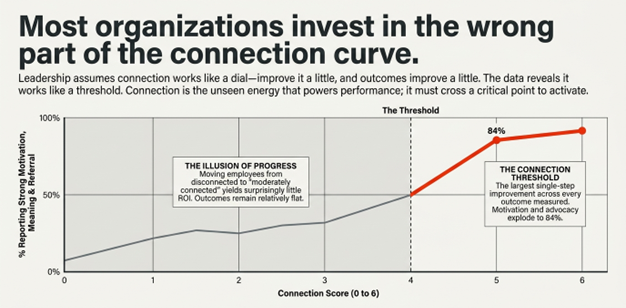
Most leaders view engagement as a linear scale: “improve by 10%, and we’ll get a 10% return.”
Key insight: Attempts to bring “disengaged” employees up to the “average” level have almost no effect. Motivation and loyalty metrics remain flat at levels 0-4. The real breakthrough occurs at the threshold between 4 and 5 points:
At a “4” rating, only 50% of employees are loyal and motivated.
At a “5” rating, this figure soars to 84%.
Invest in those who are already on the verge of high engagement with the company—that’s where the maximum return on investment (ROI) lies. And, of course, foster a culture with fewer disengaged employees.
Our Recommendations for Building Connection Within Your Company
A high level of connection—which serves as the foundation for high productivity—is the result of addressing several factors.
1. Developing a people-centered culture. Foster an atmosphere of psychological safety, a culture of trust and care for people, and a culture that supports diversity and the freedom to be oneself without fear
2. Transparent, regular communication: regularly update employees on the company’s strategy, paint a vision of the future, and discuss the paths to achieving it and their contributions. And, of course, know how to hear and listen to employees. Only then can you align the company’s goals with people’s personal interests
3. Leadership development: Eliminate toxicity; develop and support modern, empathetic, and open-minded leaders
4. Designing Work Processes: Create conditions for work with maximum transparency and convenience for employees; develop these processes based on feedback; and create an environment where everyone can perform at their best.
These steps, along with developing a people-centered approach to your business, will form the foundation for its growth and success in today’s environment.