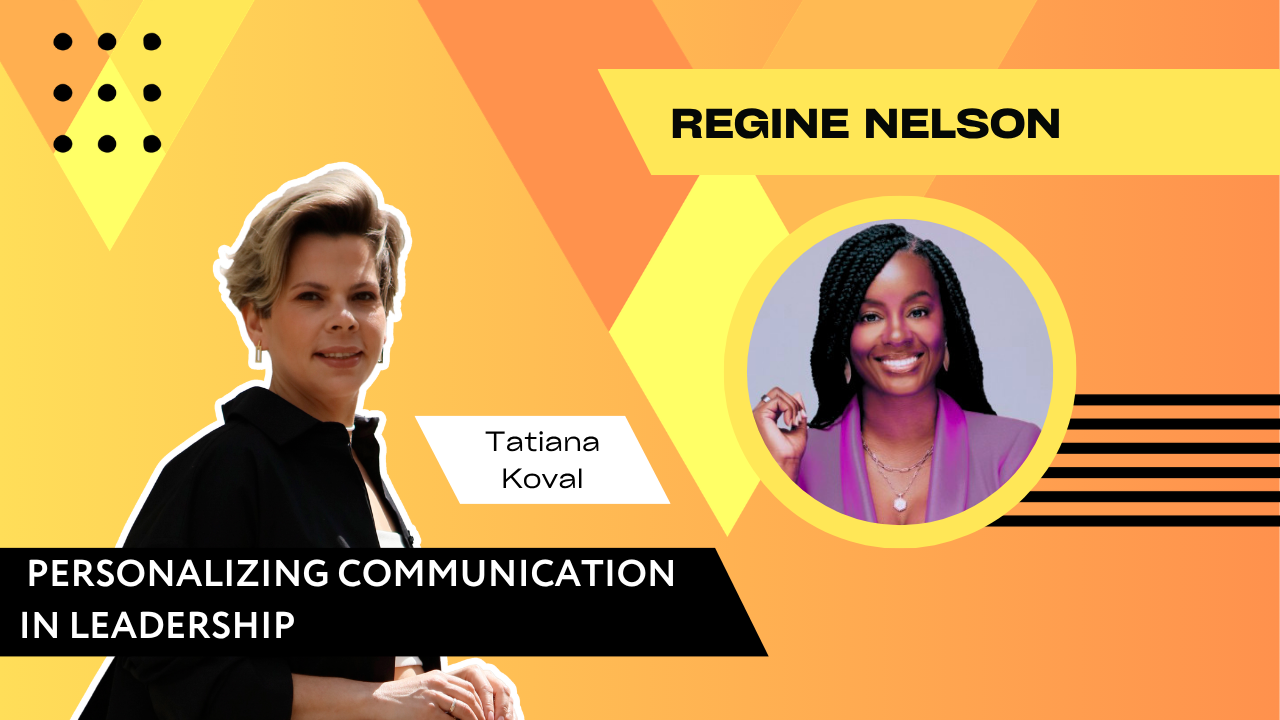
In a recent episode of the Happy at Work podcast, host Tatiana Koval sat down with internal communications and employee engagement consultant Regine Nelson for an insightful conversation on modernizing workforce communications.
Together, they unpacked why the traditional "one-size-fits-all" broadcast email is failing today's diverse, multi-generational workforce, how communicators can creatively leverage tools like the Enneagram to segment internal audiences, and how to preserve an authentic human touch in the age of AI.
Below are the top takeaways distilled from their discussion. You can check out the entire episode on YouTube below or listen on Spotify or Apple Podcasts.
Top 5 outcomes from episode
1. Personalize delivery without changing your core message
Keep the organization’s voice consistent while adapting the channel, timing, format, or level of detail to what different audiences prefer.
2. Learn about employees as carefully as you learn about customers
Use surveys and conversations to understand how people want to receive information. Job title and location alone may not tell you what will make a message relevant.
3. Use smaller, relevant audience groups to reduce communication overload
Broad messages may make sense for major company-wide updates, but teams, regions, and roles may need focused follow-ups and context.
4. Use personality tools thoughtfully to support communication and participation
Assessments such as Enneagram, DISC, and Myers-Briggs can offer ways to think about communication preferences and group dynamics. They can help teams create space for people who might otherwise be less likely to speak up.
5. Let AI assist, but keep a human in the process
AI can help brainstorm and organize ideas, but people need to review the content, add context, and make sure it reflects their voice and judgment.
Subscribe to our newsletter
The single, broadcast-style corporate email blast sent to an entire enterprise is officially dead. If your organization still relies on top-down communication blasts to drive alignment, you’re not just wasting operational bandwidth—you are actively eroding employee trust and accelerating communication fatigue.
Look back 50 years: the corporate workforce was largely homogenous, geographically concentrated, and structured around traditional top-down hierarchies. Today, for the first time in modern history, organizations manage four to five generations working side by side. Compounded by rapid globalization, remote infrastructure, and cross-cultural operations, the modern workforce presents unprecedented demographic and operational complexity.
Consider a simple operational update: a corporate broadcast sent verbatim to a 25-year-old software engineer in Austin, Texas will not land with the same context, tone, or relevance for a 52-year-old operations manager in Manila. Employees bring vastly different lived experiences, technological fluencies, and day-to-day working environments—spanning executive corporate offices, research labs, manufacturing plants, and remote field sites.
Words, formats, and channels do not translate uniformly across these groups
To build genuine clarity, mitigate ambiguity, and drive organizational transformation, internal comms must evolve. We must move away from generic broadcasts and build a targeted, audience-first communication architecture.
Here are 5 strategic takeaways to transform internal communications from administrative noise into a strategic business driver.
1. Stop Guessing: Mine Internal Data Like You Mine Consumer Data
Enterprise organizations invest millions of dollars in external market data. Marketing and sales engines track consumer habits, channel preferences, purchasing triggers, and micro-demographics down to executive tenure and company size. They prospect meticulously because targeting drives action.
Internally, however, enterprise communicators operate in a data vacuum.
Beyond basic HR administrative data—job title, direct manager, department, and physical office location—most organizations collect zero intelligence on how employees actually consume, digest, and act on critical information.
To overcome this, senior communication leaders must establish internal prospecting. By deploying targeted operational surveys, you can mine actionable employee baseline preferences:
- Channel Resonance: Which teams engage with visual infographics, asynchronous video summaries, or written briefs?
- Optimal Cadence: What times of day yield peak reading comprehension versus superficial skimming?
- Actionable Formats: Which vehicles deliver the highest conversion rates on policy updates or organizational changes?
“You need to know who your audience is first to be able to create messages that will resonate with them... External marketing does a really good job of doing that, but we don’t really prospect and mine internally as much.” — Regine Nelson, Internal Communications & Employee Engagement Consultant
2. Adapt the Vehicle, Preserve the Voice
A frequent pushback from senior leadership is the fear that segmenting communications will dilute the corporate brand voice or create unsustainable operational overhead.
This stems from a fundamental misunderstanding of what message customization actually means. Personalizing internal communications does not mean altering your core executive tone or core corporate identity.
Customization is about strategically modifying the vehicle, timing, and density of your payload—not changing the voice itself:
- Variable Timing: Dispatching strategic briefs in the morning for early-shift operational teams, while queuing updates for afternoon review blocks for field teams.
- Information Density: Implementing “Smart Brevity” principles. Placing a high-level executive summary (TL;DR) at the top of an announcement satisfies time-constrained, direct leaders. Providing deeper analytical links below accommodates employees who require full contextual backgrounds.
- Multi-Vehicle Distribution: Re-packaging a single, core strategic message across short video snippets, visual workflows, and written briefings while preserving the exact same underlying brand narrative.
By maintaining brand consistency while flexing delivery mechanisms, you maintain organizational alignment without sacrificing clarity.
3. Repurpose HR Psychological Profiling for Strategic Communication
Psychological frameworks like the Enneagram, Myers-Briggs, and DISC are routinely sequestered within HR onboarding or team-building icebreakers. However, forward-thinking communications leaders leverage psychological profiling to optimize meeting dynamics, manager enablement, and psychological safety.
How this works in practice depends heavily on organizational scale. At a massive, highly matrixed enterprise like Google (with over 200,000 global employees), broad top-down messaging from the CEO is a necessity for overarching alignment. But at mid-sized tech firms—such as enterprise database provider Couchbase (around 1,200 employees)—granular, psychological segmentation becomes actionable.
At Couchbase, leaders required all people managers to complete a free Enneagram assessment, paired with a dedicated one-hour 1-on-1 debrief. This initiative mapped managers across nine distinct personality styles, unlocking powerful communication insights:
- Balancing High-Dominance Dynamics: Enneagram “Eights” are naturally assertive, direct, and driving leaders (such as Couchbase’s former CEO). In group discussions, dominant types can unintentionally silence quieter, consensus-driven profiles (like Ones or Sevens). Mapping these dynamics allowed leaders to structure breakout sessions intentionally so quieter voices were heard.
- Fostering Managerial EQ: Intentionally pairing contrasting personality profiles in working groups helped managers build emotional intelligence (EQ), training them to deliver feedback and communicate effectively with direct reports who process information differently.
- Driving Mindset vs. Skillset Readiness: Effective communication requires managing two distinct states: Mindset (ensuring employees are psychologically ready to receive change) and Skillset (equipping them with the tactical capability to act). Profiling allowed managers to gauge whether direct reports needed empathetic contextual framing or immediate procedural toolkits.
- Subscribe now
4. Keep the Human Touch to Avoid AI-Generated Slop
Generative AI offers unprecedented scale for internal comms, but unrefined AI output poses a direct threat to brand governance and organizational trust. When fed basic, generic prompts, AI defaults to the precise middle of the statistical bell curve—producing sterile, homogenized text that employees immediately dismiss as corporate “slop.”
Unrefined AI text is merely a “butter and bread sandwich.” It provides basic structural sustenance, but it is unappetizing and unpersuasive on its own. The strategic value of the human communicator is to supply the missing context—adding the “lettuce, ham, fancy cheese, and mayo” through authentic tone, organizational nuance, and strategic alignment.
The Governance-First AI Comms Workflow:
- Raw Human Input: Capture authentic, unedited human thought first. Use dictation tools, audio recordings, or free-form braindumps to capture institutional context and genuine voice.
- AI Structural Synthesis: Feed your raw voice transcripts or bullet points into AI to synthesize, format, and organize the thoughts into a structured draft or multi-channel template.
- Human Editing & Refinement: Rigorously edit, fact-check, and contextualize the output. Inject institutional nuance and verify tone before publishing to protect brand credibility.
“You can’t just let AI do all of the heavy lifting for you. You have to remain the human within the process, whether it’s putting the content in, editing it once it comes out, and making those necessary changes.” — Regine Nelson
5. Practice the “Triple Curiosity” Framework
To build a resilient internal communications function that navigates ongoing transformation, communication leaders must cultivate continuous curiosity across three distinct pillars:
I. Curiosity About People
Look beyond organizational charts. Conduct informal pulse check-ins and build cross-functional relationships. Understand how employees outside your immediate group operate day-to-day, how they process information, and how their individual responsibilities tie into the executive vision.
II. Curiosity About the Business
Master the macro-level mechanics of your enterprise. Understand how your company generates revenue, acquires and retains customers, and builds product value. Communicators do not need to write code or build products, but they must thoroughly comprehend engineering workflows, operational roadmaps, and financial priorities to articulate their strategic impact clearly.
III. Curiosity About the Profession
Continuously benchmark your internal function against industry standards. Read case studies, network with cross-industry peers, attend conferences, and stay educated on emerging workplace technology. The moment a communicator stops investigating how people think and how business moves, their messaging loses relevance.
Transforming internal communications requires a balanced focus on Mindset and Skillset.
If your workforce lacks the psychological readiness (Mindset) to embrace change, no amount of glossy messaging will inspire action. Conversely, if your employees have the right mindset but lack clear, practical instructions and execution tools (Skillset), transformation stalls.
When you abandon generic email broadcasts and commit to deliberate internal segmentation, internal communication ceases to be administrative overhead—it becomes a strategic driver of organizational performance and culture.
How does your organization currently segment its internal communication—and which of these five strategies could make the biggest impact on your workplace culture? Drop your thoughts in the comments below!