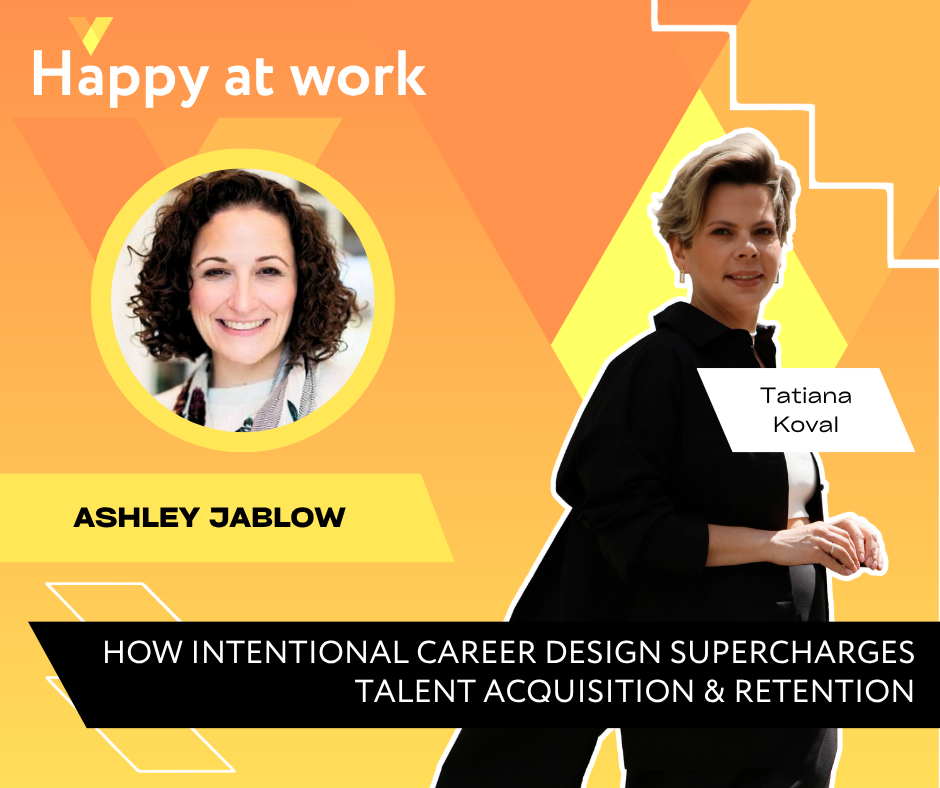
Is your workplace culture stuck in colorful Post-it notes and unwanted corporate swag? Human-centered innovation isn't about rapid brainstorming; it is a strategic, empathy-rooted mindset that transforms the internal workplace experience across the entire employee lifecycle. In this feature based on the Happy At Work podcast, host Tatiana Koval speaks with design thinking practitioner and executive coach Ashley Jablow about why leaders must "go slow to go fast." Discover how replacing assumptions with deep curiosity, active listening, and open-ended questions can bridge leadership disconnects, humanize hiring and team reorganization, and turn employees into passionate brand evangelists
Achievable Recommendations
- Embed Empathy Across the Entire Employee Lifecycle: Move beyond applying human-centered design solely to customer products. Bring holistic empathy into job candidate experiences, team onboarding, strategic planning, and reorganizations.
- Master Open-Ended Diagnostic Questions: Replace binary yes/no questions with story-building prompts like "Tell me about..." and follow up with "What’s important about that to you?" to surface core motivators without causing defensiveness.
- Embrace "Go Slow to Go Fast": Resist the urge to rush internal transformations. Pausing to understand employee needs and cultural nuances upfront accelerates alignment and adoption later.
- Eliminate Assumptions About Employee Recognition: Avoid generic corporate perks that end up resold online. Ask team members directly what form of appreciation—such as flexible PTO or targeted support—would be truly meaningful to them.
- Practice "Leaders Go First" Vulnerability: To build an empathetic workplace, leaders must role-model transparency and show up as whole people, permitting employees to do the same
Questions This Episode Answers
- How can design thinking and human-centered design redefine internal workplace culture beyond product development?
- What open-ended questions should leaders ask to uncover deep employee motivations and pain points?
- Why do top-down leadership mandates often trigger employee resistance during reorganizations, and how can leaders bridge this gap?
- How does the "go slow to go fast" methodology reduce friction when managing culturally diverse and remote teams?
- In what ways can authentic empathy turn team members into genuine brand evangelists for their organization?
Links & Resources Mentioned
Subscribe to our newsletter
The Empathy Mindset: Reimagining the Employee Lifecycle
In a high-performance corporate context, empathy is not about “being nice.” It is a disciplined methodology for understanding the employee journey from applicant to advocate. It requires the ability to step into another person’s experience to identify pain points, hidden wishes, and misaligned goals.
By evaluating the employee lifecycle through this lens, we can diagnose where traditional bureaucracies fail:
- Hiring: The job seeker’s experience is currently defined by a clinical “outside looking in” perspective. An empathy-led approach, drawing on the human-centered principles popularized by firms like IDEO, treats applicants as “whole people,” seeking to understand their holistic potential rather than just their transactional data.
- Reorganizations: When leadership formulates a new strategic plan or set of values, the traditional approach is top-down and opaque. Strategic empathy requires active listening during the formulation phase, ensuring the new direction reflects the team’s lived reality before the ink is dry.
Identifying the Gaps:
- Recruitment Gap: Treating applicants as data points; lack of holistic understanding.
- Design Thinking Opportunity: Designing a process that recognizes the candidate as a “whole person” with unique goals and values.
- Strategy & Reorg Gap: Mandatory changes dictated from the top without employee input, leading to “innovation agendas” that no one follows.
- Design Thinking Opportunity: Using generative listening sessions to inform strategic plans and organizational values.
- Communication Gap: Transparency provided only after decisions are finalized.
- Design Thinking Opportunity: Bringing the team through the design process with transparency and active curiosity to ensure alignment.
Strategic Patience: The ‘Go Slow to Go Fast’ Methodology
The paradox of “going slow to go fast” underpins sustainable workplace design. Investing time upfront to be curious and to pause may feel counterintuitive, but it prevents the friction of employee resistance that inevitably follows a rushed mandate.
In this phase, the practitioner acts as the Innovator as Translator. This role is critical, as illustrated by the experience of serving as a White House Presidential Innovation Fellow. In large-scale bureaucracies, leadership often sets a strategic mandate for transformation that completely ignores the employee base. The result is often “outright stubbornness, frankly,” and deep-seated animosity.
The highest value a strategist provides is naming these gaps—identifying exactly where leadership’s vision and the employee’s reality diverge. Without this pause to translate and align, organizations waste years trying to force change on a culture that is fundamentally unready to receive it.
Leveraging Diversity as a Design Engine
Diversity is more than a demographic requirement; it is a “forcing function” for organizational innovation. The more diverse perspectives—spanning culture, language, race, and lived experience—brought into a generative session, the more resilient the ultimate solution will be.
To unlock this value, leaders must adopt a “beginner’s mind.” This is vital when leading cross-cultural teams across the US, Asia, Latin America, and Europe. A leader who is curious about local norms and cultural connection points can design an experience that intentionally brings everyone in, rather than leaving it to chance.
“Curiosity is the ability for a leader to pause and consider: What might I learn about my people that can help me bring us all together? Within a design thinking mindset, we must choose curiosity over assumptions.”
The necessity of virtual facilitation during the pandemic proved that inclusive design is possible regardless of time zone or location. It forced a shift to tools that let leaders bring people together effectively, creating a shared experience that transcends physical boundaries.
The Tactical Toolkit: Questions that Excavate Value
The quality of an organization’s workplace culture depends on the quality of the questions its leaders ask. To move beyond surface-level data, leaders should utilize specific techniques to “excavate” deeper layers of motivation:
- “How might we...”: A classic tool from the IDEO toolkit, this starter invites broad possibility and aspiration. It moves the team away from “why we can’t” and toward a generative “what if we could.”
- “Tell me about...”: This open-ended prompt elicits stories rather than binary data points. While yes/no questions yield limited information, “Tell me about...” warms people up and encourages them to share memories and experiences.
- “What’s important about that to you?”: This is the ultimate excavation tool. It avoids the “Why” trap, which often triggers defensiveness by forcing employees to justify their positions. Instead, this question uncovers the underlying emotional drivers behind a request or a frustration, making the employee feel seen rather than interrogated.
Leadership as Role-Modeling: The “Whole Person” Mandate
Empathy-based design cannot be delegated to HR; leadership must role-model it. This requires a sharp distinction between Doing and Being:
- Doing: Refers to the tactical decisions, behaviors, and actions a leader takes.
- Being: Refers to the values, qualities, and psychological safety a leader embodies.
Leaders must “go first.” If you want a team to share where they are struggling, you must first permit yourself to show up as a “whole person.” No rule book exists for leadership; the most effective leaders model the vulnerability and curiosity they expect from their teams. By showing up as a whole person, you give your organization permission to do the same.
KPIs of the Human-Centered Workplace: From Retention to Evangelism
Success in a human-centered workplace is measured by organizational sustainability metrics that go beyond traditional productivity scores.
- Retention: While “unsexy,” longevity is a primary indicator of health. It is significantly more expensive to acquire a new employee than to retain one who is developing skills and moving through the organization.
- Employee Evangelism: A key metric is whether employees champion their employer in their own communities.
A failure of empathy is most visible in the “Facebook Marketplace” phenomenon. During the holidays, you can identify which major companies are headquartered in a city by observing which generic corporate gifts—specifically AirPods and branded water bottles—are trending for resale. This suggests the reward was based on assumptions rather than what employees actually value.
The Courage to Pause
Embedding design thinking into the core of a business is a strategic necessity, not an optional exercise. However, shifting toward a human-centered culture requires a specific type of bravery: the courage to pause.
In a world that demands constant speed and is increasingly dominated by AI, human-centeredness is the only moat an organization has left. Deciding to stop, gather the team, and ask, “What is the right move here?” is a radical act of leadership. When you choose curiosity over assumptions, you build a resilient, sustainable culture where people love where they work and are empowered to do their best.