Are your employees showing up on Monday ready to thrive, or are they just trying to survive until Friday?
Many professionals suffer from the dreaded "Sunday Scaries"—that heavy feeling of anxiety that sets in over the weekend as they anticipate the upcoming work week. But according to workplace consultant and executive coach Kon Apostolopoulos, people don’t hate Mondays; they hate how Mondays feel. More importantly, the power to change that feeling lies almost entirely in the hands of leaders, who control up to 70% of an employee’s disposition and productivity.
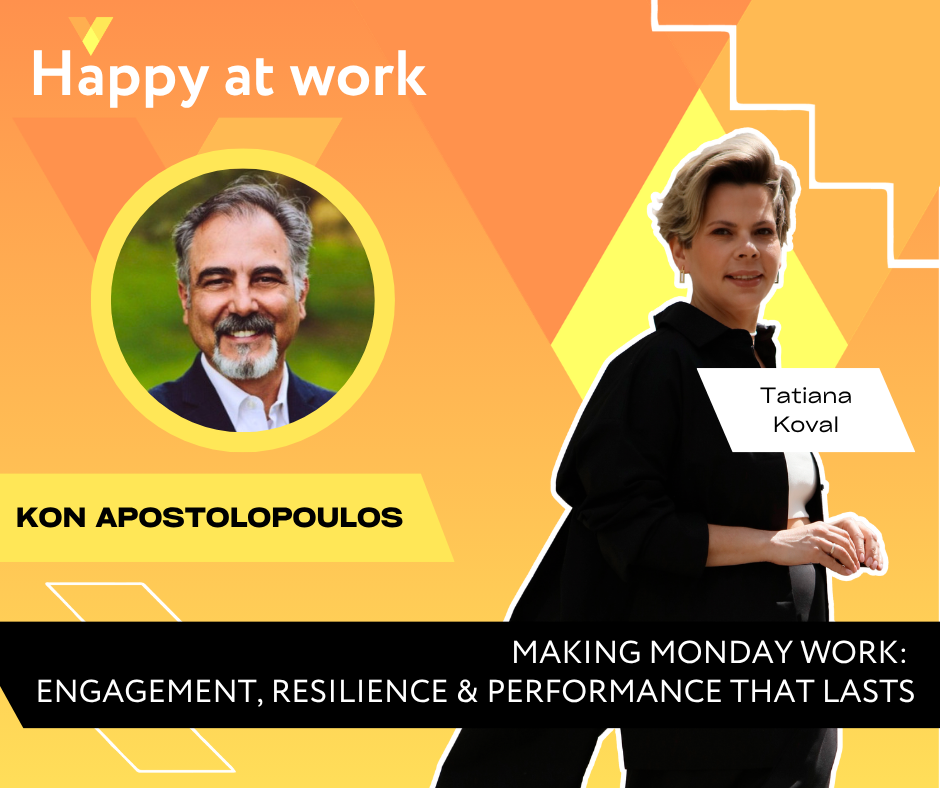
In this episode of the Happy At Work podcast, host Tatiana sits down with Kon to discuss the "making Mondays work" methodology. They dive deep into the simple, zero-budget shifts that supervisors can implement immediately to move their teams out of survival mode, foster a high-trust environment, and cultivate sustainable high performance without burnout.
Achievable Recommendations
- Create Psychological and Emotional Safety: Establish a work environment where team members feel comfortable expressing themselves, sharing new ideas, and talking openly about what is or isn't working, without any fear of negative consequences or punishment.
- Show Focused Attention: In an economy that constantly fights for attention, offer your team your undivided attention. When sitting down with an employee (even for just 5 minutes), close your laptop, put your phone away, make eye contact, and actively listen.
- Embrace the "Leadership Paradox" for Remote Teams: When managing remote knowledge workers, balance managing outcomes with showing deep empathy. Be intentional about creating "high-touch" personal connection moments since they do not happen naturally in virtual settings.
- Surgically Practice Gratitude: Move away from purely transactional relationships ("I pay you a paycheck, so do your job"). Express sincere appreciation and "thank yous"—when employees feel genuinely valued as human beings, they naturally offer their discretionary effort.
- Water Your Own Grass: Don't look at other organizations, thinking the grass is greener on the other side. As a leader, your team is your garden—nurture and water it by building strong team resilience, driving clear engagement, and aligning people with the right roles
Questions This Episode Answers
- Do people actually hate Mondays? No, they hate how Mondays feel. The start of the work week often triggers anxiety because of work environment issues, which can be reshaped by leadership.
- How much impact does a supervisor have on employee engagement? A massive impact. Leading research shows that up to 70% of an employee's productivity, disposition, and overall effectiveness is determined directly by their relationship with their direct supervisor.
- How can leaders build trust with remote and multinational teams? By practicing consistent transparency, balancing outcomes over raw outputs, and being highly purposeful in creating personal connection moments.
- What are the three pillars of a healthy workplace culture? Engagement (making people feel valued, connected, productive, and supported), resilience (building muscles to navigate the unexpected), and performance (focusing on optimizing people, processes, and the organization).
- How do you build a human-centered workplace on a tight budget? Through interpersonal relationship-building. Respect, safety, gratitude, belonging, and attention cost absolutely nothing but yield substantial results in employee self-esteem and effort
Links & resources mentioned
Subscribe to our newsletter
Takeaway 1: You Control the ROI of Your Team’s Disposition
The first step in organizational transformation is acknowledging that Monday is a neutral calendar event. The dread is a reaction to the environment, not the day. As a leader, you are the primary architect of that environment.
Research consistently indicates that the relationship with a direct supervisor is the single most influential factor in an employee’s professional life. Consider the strategic implications of this statistic from the source:
"Leaders have the biggest impact on their teams and how they feel. Many say as much as 70% of a person's disposition, productivity, and how effective they are at work is controlled by that relationship between them and the supervisor."
From a strategist’s perspective, this 70% is your leverage. If you control 70% of a person’s disposition, you essentially control 70% of their potential productivity and discretionary effort. Neglecting this relationship isn't just "bad management"—it’s a failure to optimize your organization's most expensive asset.
Takeaway 2: The Four Pillars of an "Ignited" Team
To move a workforce from stagnant survival to "ignited" engagement, leaders must satisfy four primal human needs. Apostolopoulos categorizes these as the bedrock of a high-performance culture:
- Feeling Valued: Employees must believe their presence matters. When a value is established, people naturally exceed their job descriptions.
- Connection and Belonging: Humans are tribal. By sharing values and narratives, leaders transform a collection of individuals into a cohesive "tribe" working toward a mission bigger than themselves.
- Productivity and Meaning: People need to see the "Big Picture" and, more importantly, their place within it.
- Support for Growth: Stagnation is the silent killer of engagement.
"Where am I in this picture?" Kon uses a brilliant metaphor: when people look at a group photo, the first thing they do is look for themselves. In a professional context, if an employee cannot see where they "fit" in the organizational snapshot, their work loses meaning. Without that clarity, they aren't moving; they are merely existing.
"You can look at a swamp, and you can look at a river. The difference between the two is that one is stagnant; it doesn't move... but a river flows, a river has movement. People want their career to have movement just like the river; they don't want to feel like they're stuck in a swamp."
Takeaway 3: The $0 Leadership Toolkit for Discretionary Effort
Cultivating a world-class culture doesn't require a massive HR budget; it requires a shift from transactional to transformational leadership. Transactional relationships (a paycheck for a widget) only yield the bare minimum. To earn "discretionary effort"—that extra mile that carries a company through a crisis—you must utilize these high-impact, zero-cost tools:
Psychological Safety Innovation cannot exist without the safety to fail. Leaders must cultivate an environment where ideas are voiced and errors are reported without the looming threat of retribution.
The Two Flavors of Respect Respect is the foundation of the workplace, but it manifests in two ways. There is the foundational respect owed to every human being, and the additional respect earned through performance. A strategist knows that if you fail to provide the first, you will never see the results of the second.
Attention: The Hardest Currency In a world of constant digital distraction, undivided attention is the ultimate sign of respect. Giving a team member five minutes of focused eye contact—laptops closed, phones away—signals that they are valued. In the modern economy, your attention is your most precious resource; spend it on your people.
The Power of Gratitude: A "thank you" is the bridge between a cold transaction and a human connection. When gratitude is baked into the culture, employees stop working for a paycheck and start working for the mission.
Takeaway 4: Mastering the Leadership Paradox in the Knowledge Economy
The transition from the "factory mindset" to the knowledge-worker model requires leaders to navigate the Leadership Paradox: the ability to hold two opposing ideas in tension. This is especially critical for remote and multinational teams.
Strategic leaders must balance these two specific pairings:
- Empathy vs. Tough Love: You must relate to your team as complex human beings while maintaining uncompromising boundaries and clear expectations.
- Outcomes vs. Outputs: In the factory model, we tracked "widgets." In the knowledge economy, we must track "outcomes." A developer might delete a day’s worth of code to find a better solution; that is a high-value outcome, even if the "output" looks like zero.
In remote environments, leaders must be "High Tech and High Touch." Technology is the platform, but "High Touch" is the purposeful leadership action. Because spontaneous "water cooler" moments don't exist in digital spaces, you must intentionally manufacture human moments to prevent isolation.
Takeaway 5: The Truth About "Greener Grass"
High turnover is often blamed on a "lack of talent" or "better offers elsewhere." However, the "greener grass" syndrome is usually an indictment of the current environment.
"The grass is greener where you water it. Where you take care of it, that's where the grass is green. As a leader, I can water my grass... I can work with my people to create a beautiful garden that we all want to be a part of."
Watering the garden is not a one-time HR initiative or a yearly retreat; it is a consistent, daily behavior. If your "lawn" is brown, stop looking at the neighbor's fence and start looking at your own irrigation system.
Conclusion: A Strategic Monday Reset
Culture is "the way we do things." To move the needle on your organization's performance, adopt this three-part framework:
- Engagement: Ensure every individual feels valued, connected, and productive.
- Resilience: Build the "team muscles" necessary to navigate volatility and unexpected change.
- Performance: Align your people and processes to focus on meaningful outcomes over empty outputs.
If you don’t like the culture of your Mondays, you must change your actions.
The Challenge: Look at your calendar for the coming week. Are your planned interactions designed to catalyze growth, or are they contributing to stagnation? Most importantly: Is your leadership style creating a river or a swamp this Monday morning?