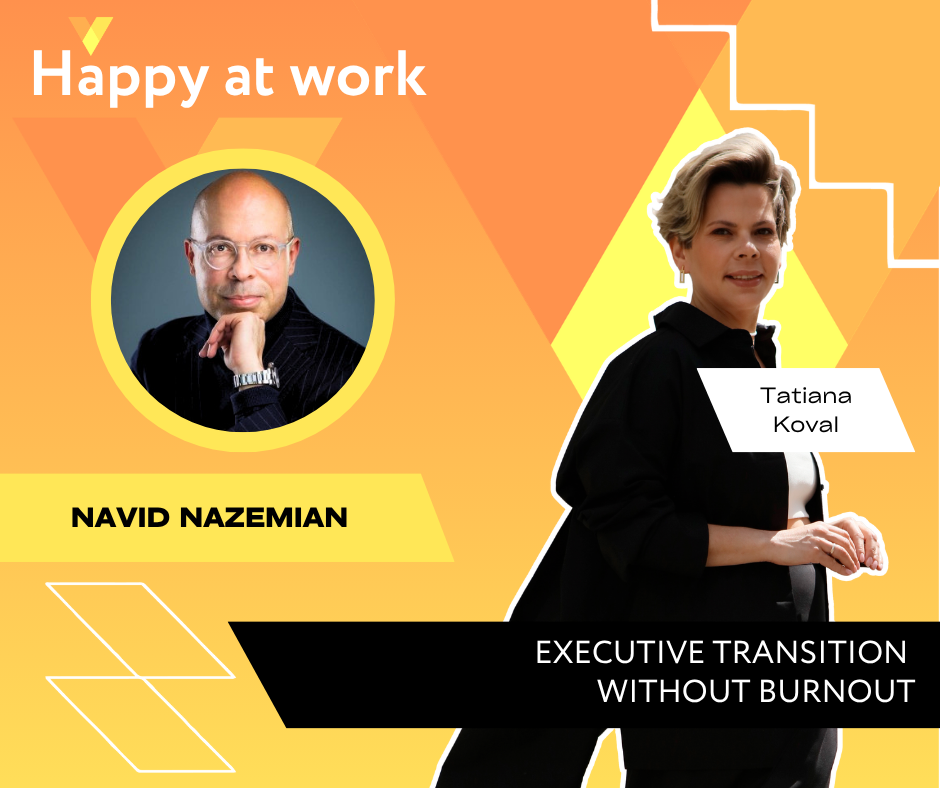
Whether you are stepping into a C-suite role, managing organizational change, or striving to build a thriving workplace culture that outperforms industry peers. In this featured episode of the Happy at Work podcast, host Tatiana Koval speaks with globally recognized executive coach and author Navid Nazemian to unpack what truly defines leadership in today’s rapidly shifting business landscape. Drawing on his extensive experience advising C-suite leaders across five countries and six industries, Navid cuts through theoretical buzzwords to share pragmatic, research-backed strategies for mastering executive transitions, driving team impact, and sustaining high performance.
Top 5 Insights You Will Learn from This Episode
1. Extraordinary leadership is a balancing act, not a personality type
The strongest leaders are not just confident. They pair confidence with self-awareness, connection with inspiration, and courage with clarity. Power comes from holding the pair together, not overusing the trait that comes most naturally.
A leader can be brilliant in a boardroom and still fail if they cannot see themselves clearly, reach people below their own level, or communicate in a way that makes others want to follow.
2. The best leaders do not perform certainty when reality is uncertain
In a crisis, confidence is not pretending to have the answers. It is admitting uncertainty while creating a reliable rhythm of communication and action. Humility can be a stronger signal of leadership than certainty.
During the pandemic example, the CEO did not invent false scenarios or claim precision. He said he did not know how long it would last, but he committed to daily updates for 101,000 employees. That is confidence under pressure.
3. Strategic self-awareness is the hidden skill that separates strong executives from merely successful ones
Self-awareness is not just knowing your strengths. It means understanding your bright side, dark side, and deep motives, then actively managing them in real situations. The key trait is not insight alone, but insight plus a development plan.
The research cited on top CEOs pointed to one repeated trait—strategic self-awareness. These leaders knew what energizes them, what triggers them under stress, and what habits they need to work on every day.
4. Leadership is situational, and style must change before the context forces it
There is no single best leadership style. A leader must be able to switch modes based on the moment—directive when the ship is about to hit the iceberg, coaching when people need to learn, cooperative when the situation allows it.
If the iceberg is visible, the right move is not a long consultation. It is clear command. The leader who can play all the keys is more useful than the one who only knows one tune.
5. Culture is not soft, it is an economic engine
Culture is one of the strongest magnets for talent and one of the cheapest forms of retention. It shapes engagement, customer experience, and even performance relative to peers.
The Vodafone example mattered because the engagement score stayed above major global benchmarks like Google and Apple for years. That kind of culture becomes a reason to join, a reason to stay, and a reason to perform.
6. Behavior change works when it is designed, not wished for
Sustainable leadership growth is easier when you break behavior change into start doing, continue doing, and stop doing. Each one needs both a one-off action and a longer-form habit shift.
If a leader is too direct, the work is not just “be less direct.” It might mean apologizing once, practicing a new kind of response repeatedly, and deliberately reducing the old behavior in contexts where it causes harm.
Ready to elevate your leadership capability? Tune in to the full episode of Happy at Work for actionable takeaways, real-world case studies, and expert recommendations from Navid Nazemian!