If your employees are burning out, it’s pointless to send them to meditation classes—you need to change the work system itself. In this podcast episode, organizational psychologist Kat Page turns conventional wisdom on corporate well-being on its head, arguing that chronic fatigue and loneliness in the workplace aren’t signs of personal weakness but the direct result of flaws in the design of work processes. Learn how to move from the concept of “fixing the employee” to designing a truly healthy, safe, and high-performing work environment at all levels: from the individual level to the company-wide macro-system.
Achievable recommendations
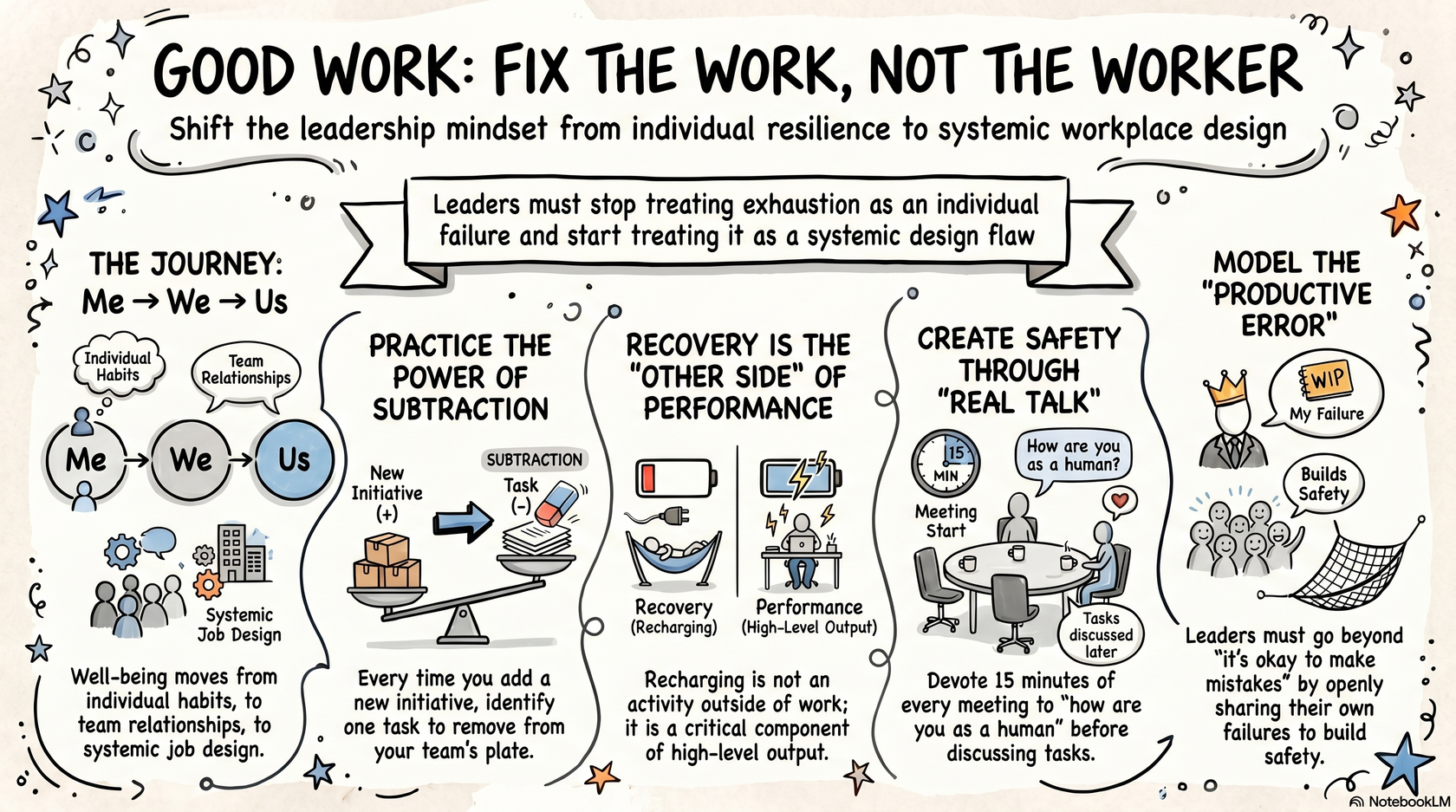
- Practice “smart subtraction” of tasks, rather than endlessly adding to them. Most modern companies suffer from resource shortages and employee overload. Every time management decides to implement a new initiative, transformation, or technology, leaders should ask themselves:
“What can we remove from our current processes (unnecessary reports, redundant meetings, excessive approvals) to make room for the new?”
- Divide one-on-one conversations into “personal” and “work-related” parts. Instead of jumping straight into a to-do list during one-on-one meetings, set aside the first 15 minutes for a sincere conversation about how the employee is doing as a person, how they’re coping with stress, and what’s going on in their life. Setting aside this symbolic time shows the employee that they are valued for who they are and helps spot burnout early on.
- Change how mistakes are handled by leading by example. Saying that “it’s okay to make mistakes” doesn’t work if a second of praise for taking a risk is followed by half an hour of dissecting shortcomings. To create genuine psychological safety, top managers need to publicly share stories of their own “best mistakes” and “productive missteps” that led to valuable innovations.
Questions This Episode Answers
- What is the concept of “Good Work,” and how does a well-designed work environment simultaneously protect employees’ mental health and improve business performance?
- What is the key difference between psychological safety and psychosocial safety, and how are these two factors interrelated in a team’s dynamics?
- How can you recognize hidden workplace bullying and a toxic culture through indirect signs at the macro level if intimidated employees are afraid to speak up directly?
- Why are people in modern organizations reluctant to talk about their stress, and how can leaders overcome this stigma by changing the language used within the company?
Links & Resources from episode
- Kat Page LinkedIn Profile
- "Good Work" by Kat Page — the book by Kat Page that draws on her 20 years of experience as an academic researcher and organizational psychologist at major corporations
- Amy Edmondson’s research on psychological safety
- David Brooks’ concept of “The Second Mountain”
Subscribe to our newsletter
Recovery is the “Other Side” of Performance
“Recovery is not something you do outside of performance; it is the other side of performance”.
If you treat recovery as an optional “extra,” you are effectively planning for a capacity crisis. Sustainable performance requires shifting the perspective from “downtime” to “recharge time” as a prerequisite for success.
Stop Adding, Start Subtracting
Organizations have a chronic compulsion to add: new technology, new transformations, and new well-being initiatives. This creates a workload problem that no meditation app can solve. True leadership in a complex environment is defined by what you choose to remove from the system to create breathing room for your team.
To break the cycle of cognitive overload and the “compulsion to add,” ask yourself:
- What can we take off people’s plates to accommodate this new task or technology?
- Which legacy processes no longer serve our core purpose and can be eliminated?
- Are we adding a well-being initiative as a band-aid for a workload problem we refuse to trim?
Fix the Work, Not the Worker
Leaders often confuse Psychological Safety with Psychosocial Safety, but the distinction is vital for health. Psychological Safety is a property of the team climate—the comfort to speak up or be vulnerable. Psychosocial Safety is a property of the system design that covers environmental factors such as job demands and workload.
Organizations default to “fixing the worker” through resilience training because it avoids the difficult task of addressing systemic flaws, such as poorly managed change or a lack of control. High control over one’s work is a protective factor, yet we often strip it away during transformations. Burnout is not a sign of a weak employee; it is a direct consequence of a system designed without regard for human limits.
The 15-Minute “Human-First” Rule
Most one-on-ones are mechanical status updates—a walk-through of a task list. To move toward “Good Work,” managers must prioritize social connection as a safeguard against the current “loneliness epidemic.” If an employee doesn’t feel truly seen, they cannot feel they matter.
Managers should dedicate the first 15 minutes of every check-in to “Real Talk” about the person as a human being. This is distinct from “small talk”; it is a symbolic investment of time that signals the individual is valued beyond their immediate output. By starting with the human, you create the safety necessary to surface issues before they become crises.
Watch the Response, Not the Policy
In a “recovering perfectionist” culture, telling employees it is “okay to make mistakes” is empty noise if your behavior signals otherwise. Employees are social creatures who watch how a leader responds to bad news or a minor formatting error. If your critique of a slide deck takes thirty minutes after a verbal permission to “fail fast,” the team receives the louder signal: perfection is the only acceptable standard.
Senior leaders must role-model vulnerability to grant the organization permission to innovate. Try running a “Productive Error” experiment where leaders openly share the “best mistake” they ever made and what it taught them. When you normalize the reality of errors, you replace learned helplessness with a sense of agency and hope.
The transition toward “Good Work” requires a clear mental model: the Me-We-Us framework. It begins with the individual’s relationship with work (Me: Attention and Flourishing), moves to team relationships and psychological safety (We: Connection and Mattering), and culminates in systemic job design and policy (Us: Systems and Environment). Ultimately, your role is to design an ecosystem where people don’t just survive, but flourish.
What can you subtract from your team’s workload today to improve their well-being?