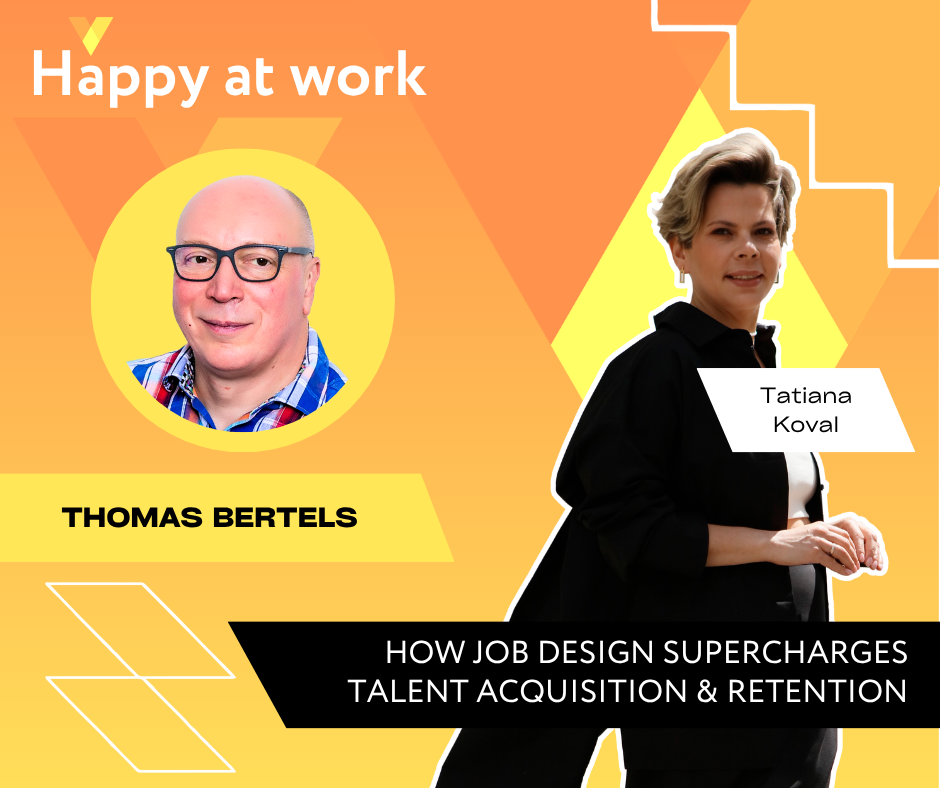
Have you ever wondered why nobody vacuums or washes a rental car before returning it to Hertz or Avis? It comes down to a simple truth: we don't take care of things we don't own. In this episode of the Happy At Work podcast, host Tatiana Koval sits down with transformation expert Thomas Bertels to unpack why so many modern roles feel uninspiring despite 60 years of job design research. Moving beyond traditional process optimization, Thomas shares how leaders can redesign entire operating models to foster true ownership, meaningful work, and sustainable high performance
Achievable Recommendations
- Evaluate roles with the "Good Job" rule: apply Richard Hackman’s core principle—"you can only do a good job if there’s a good job to be done" — by ensuring roles provide task identity, autonomy, and direct feedback from the work itself.
- Map workflows: use process mapping and RACI matrices to expose unnecessary handoffs, duplicate approval checks (e.g., standard offer letter sign-offs), and non-value-added loops.
- Empower frontline: provide employees closest to the work with the tools to analyze and propose workflow improvements, while executive leaders focus on governance and resource allocation.
- Implement AI correctly: avoid using AI purely to automate strategic or creative thinking while leaving humans with tedious data capture; instead, leverage AI to reduce administrative friction.
Questions This Episode Answers
- Why has employee motivation stalled despite decades of workplace research?
- What are the three core psychological pillars of motivational work design established by Hackman and Oldham?
- What does the "rental car" analogy reveal about employee ownership and autonomy in organizations?
- How can companies integrate AI tools without stripping away the most engaging parts of human jobs?
- Why is designing for employee happiness and operational efficiency a "triple win" rather than a trade-off?
- What diagnostic tools (such as process mapping and time inventories) reveal hidden organizational friction?
Links & Resources Mentioned
- Thomas Bertels' LinkedIn profile & Work Matters Podcast
- Hackman & Oldham's work design model (1970s): foundational academic framework defining meaningful work, autonomy, and feedback mechanisms.
- Process mapping & RACI matrix: methods for visualizing swim-lane workflows, handoffs, and accountability across teams.
Subscribe to our newsletter
The rental car rule
The fundamental reason employees often stop caring about their work can be summed up with a simple observation about human nature. Thomas notes:
“Nobody washes a rental car. When you rent a car, nobody brings it back to Hertz or Avis and says, ‘I just went to the washer, and I vacuumed the back seats.’ And people don’t do it because it’s not their car.
In a corporate environment, if an employee doesn’t feel they “own” a process from start to finish, they have no reason to invest their spirit in it. Humans crave agency—the ability to apply judgment and decision-making to a problem. When we fragment jobs into tiny, repetitive tasks, we strip away that agency. The only antidote to the “rental car” mindset is end-to-end accountability, where individuals or teams own a whole work product rather than a single, disconnected step.
The “Triple Win”: debunking the false dilemma
Leadership often operates under the delusion that they must choose between an efficient process and a happy workforce. This is a false dilemma. In reality, the most efficient processes generate the highest engagement. We call this the “Triple Win”:
- Employee Engagement: The work becomes intrinsically motivating because employees see the result.
- Organizational Effectiveness: The process moves faster because you’ve removed the friction of constant handoffs and management oversight.
- Customer Satisfaction: The customer deals with one person who has the authority to solve their problem.
Consider the “handoff” problem in insurance claims or call centers. When a customer is passed between eight departments, the experience is miserable for the customer, but it is equally damaging to the employee. By denying the employee the “Task Identity” of seeing a job through to completion, you’ve designed an inherently boring job. Efficiency isn’t the enemy of happiness; a lack of friction is what creates the satisfaction of a job well done.
“It’s not a trade-off. It really is: you can have your cake and eat it too.” — Thomas Bertels.
The AI Trap: avoiding the “Hollowed Out” job
As we rush to integrate AI, we risk “hollowing out” the American workplace. The danger is that organizations will automate the “good parts” of work—the parts that require thought and creativity—leaving humans with “NAY” tasks: Not Automated Yet.
If we use AI to handle the strategy, humans become mere data-entry clerks for the machine. Thomas warns that we are often mistakenly handing over the most interesting parts of the job to machines, specifically:
- The offering and value proposition.
- The overarching strategy.
- The final presentation of ideas.
- The high-level recommendations.
Compare the situation with education at school. Its narrow function is “knowledge delivery,” which could be automated by a chatbot. But a school’s broader functions include socialization, community building, and childcare. If you automate for the narrow function, you kill the system’s holistic value. We must apply this same logic to the workplace. If we automate the “thinking” and leave the human with only the “output,” we destroy the socialization and meaning that keep employees from quitting after 3 months.
Pillars of meaningful work
1. Meaningfulness. Does the worker believe the task actually matters to someone?
2. Autonomy. A worker must use their own judgment and make decisions without a boss’s intervention.
3. Feedback. This is what comes from the work itself, not from the boss. The worker should know they’ve done a good job just by looking at the results of their labor.
Stop Mapping Steps, Start Mapping “Swim Lanes”
Leaders are often shocked when they see the reality of their own operations. A process they believe takes five steps frequently turns out to be 59 steps that bounce back and forth between different departments. These “Swim Lanes” visually represent the Rental Car problem — fragmented ownership where eight different people drive the “car,” and none feel responsible for its condition.
To fix this, leaders must shift their role. You are not a “solution-maker”; you are an environment-creator. Your job is to:
- Conduct a work inventory: Identify where time actually goes. Find the low-priority tasks that consume high-priority time and either stop doing them or automate them.
- Empower middle managers: They are the “design authority.” They are close enough to the friction to see the problems but high enough to understand the strategy.
When you give employees the tools and governance to design their own work, they own the result. People are always more invested in a solution they helped build.
You can only do a good job if there’s a good job to do
Work doesn’t just happen; it is designed. If we don’t design it intentionally, the “weeds” of bureaucracy, handoffs, and “NAY” tasks will take over. In an AI-driven landscape, the “Triple Win” is the only sustainable path forward.
As you evaluate the roles in your organization today, ask the same question Thomas Bertels uses to diagnose the health of a job:
“If you had to do this job for the next two years exactly as it is designed today, how long would you last before you got bored?”