For years, the corporate world has operated under a convenient assumption: if we just get everyone back into the same room, the “magic” of collaboration and culture will return. We’ve treated physical presence as a cure for the post-pandemic slump, but a troubling reality has emerged. Despite the mandates and the commute, many employees feel more isolated than ever.
This is the “Disconnection Epidemic,” fueled by a fundamental misunderstanding of what actually drives human performance. According to workplace strategist Jason Lauritsen, physical proximity is a lazy proxy for genuine connection. Drawing from the Human Connection Study—a massive dataset involving over 285,000 employees — he argues that proximity does not equal connection. In fact, if not handled intentionally, the office can become the loneliest place an employee visits all day.
Achievable Recommendations: Your Connection Roadmap
For Executive & Senior Leaders: Build the Connection Infrastructure
- Establish Strategic Clarity & Tell a Compelling Story: People cannot connect to what they do not understand. Senior leadership must define a clear strategy, mission, and values, and communicate them as a cohesive narrative. This narrative must clearly articulate why the organization exists and how it impacts customers and the world.
- Role-Model Your Values in Action: Leaders must actively live and demonstrate the corporate values they preach. Employees must see a consistent alignment between executive words and organizational behaviors.
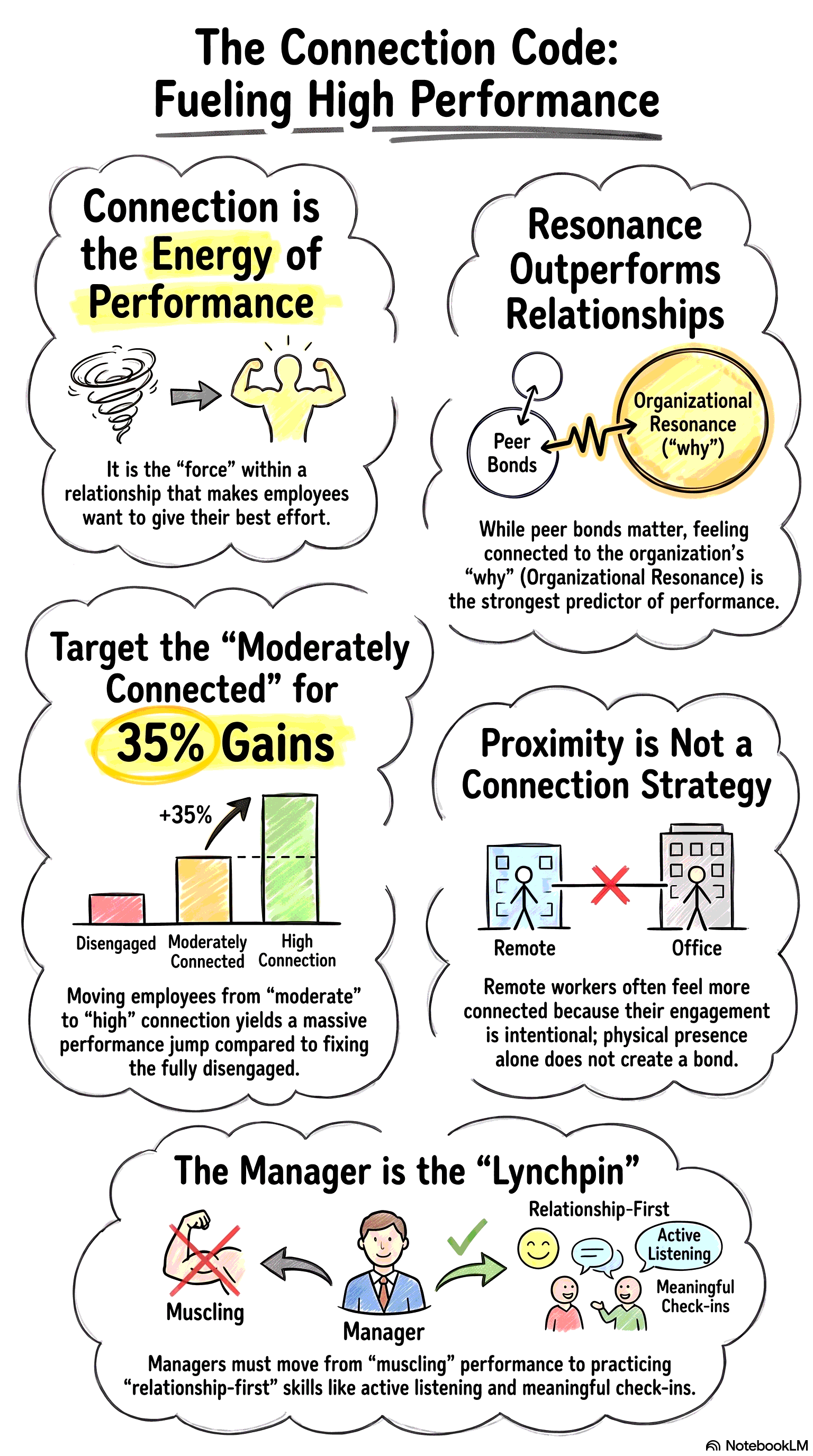
- Focus Connection Efforts Where They Matter Most: Instead of spending disproportionate energy trying to "fix" the most disconnected or lowest-performing employees (which yields very low return on investment), focus on moving the moderately connected to the highly connected. Moving employees from moderate to high connection results in a dramatic 35% jump in performance and motivation outcomes.
For Managers: Act as the "Connection Plug"
Managers are the ultimate lynchpins—they can either plug employees into the organization's energy source or cut the cord entirely.
- Develop "Relationship-First" Leadership Skills: Equip managers with the skills to listen and engage so that employees feel individually seen, heard, and valued.
- Bridge the Line of Sight: Teach managers how to conduct coaching and goal-setting conversations that explicitly connect an individual’s daily work to team goals, department milestones, and the company's broader mission. Creating this line of sight fuels organizational resonance, a powerful driver of retention and motivation.
- Facilitate Peer-to-Peer Spaces: Managers must deliberately design environments—both virtual and physical—for team members to get to know each other as human beings. Peer connection directly elevates workplace happiness and performance.
For Employees: Own Your Peer Network
- Invest in Relational Capital: Don't wait for the company to connect you. Take personal initiative to build authentic relationships with colleagues, learn about what they care about, and humanize your day-to-day interactions. Strong peer connection directly makes work feel more meaningful and enjoyable.
Questions This Episode Answers
- Why is the Return-to-Office (RTO) mandate failing to build team connection? Proximity alone does not create engagement; historical office designs have often ignored human interaction. Connection is about intentional engagement, which can be fostered just as effectively from a distance using video and collaboration tools.
- What are the different types of workplace connections, and which one is the most powerful? Connection is split into Relational connection (with people) and Resonance connection (to meaning). Resonance is further split into personal resonance (connection to one's own work) and organizational resonance (connection to the company's purpose). Organizational resonance is the single most powerful predictor of employee motivation, inclusion, and the intent to stay—yet it is the least commonly experienced.
- How do connection levels correlate with business performance? Connection serves as the upstream energy source for performance. Elevating employees from moderate to high connection unlocks a 35% increase in key performance and retention metrics, making connection-building a high-leverage business strategy.
- How should managers pivot their management styles in hybrid environments? Managers must move away from "forcing or muscling" performance through compliance. They need to acquire skills as storytellers, active listeners, and team facilitators, prioritizing relationships to elicit performance from people naturally.
Links & Resources Mentioned
The Remote Work Paradox
The research reveals a finding that shatters conventional management wisdom: non-management employees working fully on-site are the most disengaged group in the workforce. Conversely, fully remote workers report the highest connection rates.
This paradox exists because connection is not about where you sit; it is an “intentional experience of meaningful engagement” with something that matters. Lauritsen points out that for much of human history, office environments have been designed as “soul-crushing” spaces. Without intentionality, employees sit in rows of cubicles like “prairie dogs or chipmunks,” ignored and isolated, even though they are feet away from their colleagues. Simply forcing people back into a disconnected environment doesn’t create community; it only amplifies the silence.
Connection is a Two-Sided Coin: Relational vs. Resonance
To move beyond the proximity trap, leaders must recognize that employees experience work as a relationship. This relationship thrives on specific “currencies”: feeling valued, trusted, appreciated, cared for, and included. When these are missing, the relationship with the organization fails.
The Human Connection Study identifies two distinct types of connection that fuel this relationship:
- Relational Connection: The people-to-people bond, specifically an employee’s relationships with their manager and their peers.
- Resonance Connection: A sense of meaning and significance, divided into:
- Personal Resonance: Feeling that one’s specific work is important and makes a real contribution.
- Organizational Resonance: Feeling connected to the company’s broader direction, purpose, and strategy.
The Great Leadership Opportunity: Organizational Resonance
The study’s most striking finding is that Organizational Resonance—feeling connected to the company’s “why”—is the strongest predictor of performance, motivation, and retention. Yet, it is also the least commonly experienced type of connection.
This represents the single greatest opportunity for modern leadership. A senior leader’s primary job is not just operations; it is storytelling. Leaders must create a clear, accessible narrative of where the company is going so that every employee can find themselves in that story. When the strategy is a “black box,” connection is impossible.
The Manager is the “Power Cord” of Performance
If connection is the energy of performance, then the manager is the linchpin of the entire system. Connection acts as an “upstream lever”—if it isn’t pulled, all other engagement efforts are wasted energy. In this model, the manager is the “power cord”: they can either plug the employee in or cut the cord entirely.
To be an effective power cord, managers must move beyond tactical oversight and adopt “relationship-first” skills:
- Active Listening: Managers must see the employee as a human being, making them feel heard and understood beyond their output.
- Connecting the Dots: Managers must explicitly link daily tasks to the team’s goals. By creating a clear line of sight from a spreadsheet to the company’s mission, they help employees find meaning in the mundane.
Stop Trying to “Fix” the Disconnected
The research offers a counterintuitive directive for where leaders should focus their energy. Instinct tells us to spend our time “fixing” the most disconnected or disengaged employees. However, the ROI on these efforts is remarkably low.
The data shows that moving “moderately connected” employees to a “highly connected” state yields a massive 35% jump in performance outcomes. By focusing on the middle of the spectrum—those already open to connection—you maximize impact on the organization’s performance capacity.
“It feels better to lead in a connected environment, and it feels better to lead through connection than it does to try to force or muscle performance out of people.”
A Call to Action for Every Level
Cultivating connection is not a switch that can be flipped; it is an environment that must be built through intentionality.
- For Leaders: Align the house. Ensure your strategy, mission, and values are clear, then role-model them daily. If the story isn’t clear at the top, it will never resonate at the bottom.
- For Managers: Humanize the experience. Use a consistent “check-in method” to see your people as individuals. Create space for your team to connect as humans, not just as roles.
- For Employees: Take ownership. Invest time in building genuine peer relationships. It doesn’t just make you more productive; it makes work fun and more meaningful.
Are you designing your workspace for proximity or for connection? I’d love to hear how your team is “plugging in” this week—drop a comment below.